
Sunday, February 12, 2012


Monday, January 23, 2012
ALL-ROUND JUSTICE: The Call of the Master
I chose Isaiah 42:1-9 as the text for my sermon at the Chandigarh Bible Fellowship this morning. I came back with the feeling that perhaps more than anyone else, the Word spoke to me. The primary "task" of the Servant, about whom the text speaks, is to establish justice. The word justice is repeated three times in the first four verses. It is clearly a concern close to God's heart. Right now the state of Punjab is gearing up for assembly elections due next month. The candidates are going at it with hammer and tongs. They can't seem to wait to serve the state and its people. Now, politicians are meant to be servants of the people and work towards justice. But, then, who believes them? There are reports that the prime minister's rally in Amritsar today was poorly attended. Politics and politicians, at least for the time being, have lost all credibility. Now when I spoke to the congregation about the text, it hit me rather strongly, that as far as the issues of justice are concerned, the Church must wrest the responsibility. It's the church's primary task: to ensure justice being done in all aspects of our personal and corporate lives. Don't leave it to the government alone. The Church must take charge. It should not continue to feel and behave like a victim but stand up for justice for all, like it's Lord and Master did. This minor change in perspective is nothing short of a paradigm shift.
Saturday, December 31, 2011
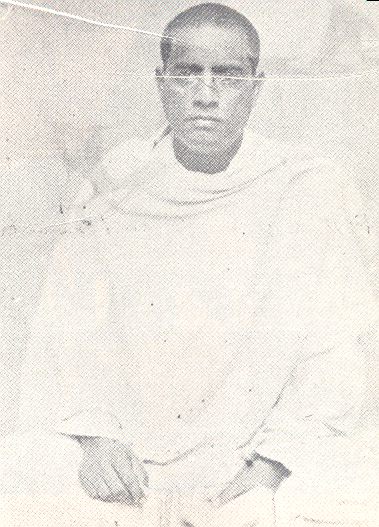
Year 2011: The 150th birth anniversary of Brahmabandhab Upadhyay
For the past few days, I've been revisiting Brahmabandhab Upadhyay. Year 2011 is supposed to be the year of his 150th birth anniversary. In 2007, the year of his death anniversary, some of us organized a small memorial function. Couldn't do much this year. Anyway, though I cannot agree with all that he said and stood for, he continues to be a fascinating figure to me. As "iamplural", he was "dual". And, as the year comes to an end, I remember him yet again. I perhaps will continue to grapple with him in the coming year.
Here's a small extract about him from his biography:
 It is not well known that it was Brahmabandhab Updhayay who helped propel Rabindranath Tagore to fame. Upadhyay first publicly noticed Tagore in a serious way in an article entitled 'The world poet of Bengal' in the weekly Sophia (September 1, 1900). With uncanny prescience he wrote:
(Julius J. Lipner, Brahmabandhab Upadhyay: The Life and Thought of a Revolutionary, OUP, 2001, p. 281)
Lipner calls him a "forgotten colossus" and suggests that we need a more psychological-oriented biography of the man. Perhaps someone should write a novel.
Here's a small extract about him from his biography:
'Rabindra is not only a poet of nature and love but he is a witness to the unseen. Revelation apart, Kant, Tennyson and Newman are considered to be three modern witnesses to the invisible world. Poor Bengal has produced another and it is Rabindra Nath.... If ever the Bengali language is studied by foreigners it will be for the sake of Rabindra. He is a world-poet.... He will be ranked amongst those seers who have come to know the essence of beauty through pain and anguish.
(Julius J. Lipner, Brahmabandhab Upadhyay: The Life and Thought of a Revolutionary, OUP, 2001, p. 281)
Lipner calls him a "forgotten colossus" and suggests that we need a more psychological-oriented biography of the man. Perhaps someone should write a novel.
Monday, November 28, 2011
No Turning Back (My memories of Rev. C. M. Khanna)
“The arrest of Rev
Khanna was shocking and humiliating. He was clearly framed and he had not
confessed to any person that he was involved in conversions by force or
allurement.”
Rt. Rev. P. K. Samantaroy, Bishop, Diocese of Amritsar ,
Church of North India
“The whole Christian
community feels humiliated because a religious leader like Rev Khanna has been
treated in a manner so undignified. The charges of forcible conversion are
totally baseless and false.”
Alwan Masih, General Secretary, CNI
My first memory of
Rev. C. M. Khanna is rather faint. He was leading a prayer meeting at a
friend’s birthday party. I might have been about three or four years old but if
there’s one thing I still remember in that birthday party is the figure of the
padre in his characteristic priestly cassock, sporting long hair and flowing
beard. We children were sitting on the durree while the adults sat on the
chairs around. Right opposite was the filigreed table for the cake and the
eateries. In front of that table stood the young priest, who looked every bit
like Jesus Christ himself. But I remember him for a peculiar reason. As he
brought us the Word of God, he had closed his eyes and he kept on swaying to
and fro. At that age, all I could think of while looking at him with an
upturned face was, why does he have to swing like that?

Second time, I was
brought to think of him was when, many years later, I was rummaging through some
old books in a modest library – just a few bookcases, actually – at the Diocese
of Chandigarh head office in Ludhiana. There were some old books on religion,
theology and philosophy. The one that interested me was a little Pelican
paperback The Shaking of the Foundations by Paul Tillich, the great
German-American theologian, an “outspoken critic of Nazism”, who was “forced to
leave Germany in 1933”. I came across Tillich’s name while reading about existentialism
but hadn’t yet found anything originally written by him. I was thrilled to see
that book and pounced on it. The book originally belonged – the rubber-stamp
impression informed me – to Rev. Chandra Mani Khanna, Assistant Presbyter, Christ Church ,
Sector 18, Chandigarh
Third time, I actually
heard him from a distance. He was addressing public meeting in Delhi England

Fourth time. I read a
news item. “Pastor held in Valley over ‘forced conversions’”. While it is a
routine thing to come across such propaganda, two things seemed particularly
odd. One, the incident happened in the Kashmir Valley
Rev. Khanna is as much
a victim of religious fundamentalism as he is of this worst kind of postmodernist
approach to journalism. The “truth” doesn’t matter, selling of the story does.
Make it sensational, pander to emotionalism, and cover up any attempt towards
rational assessment of the situation.
Like, Tillich he faces
the power of the might of the state. Government ministers have already pledged
“strict legal action” against the padre, even before the case has properly been
probed. According to reports, Minister for Law and Parliamentary Affairs Ali
Mohammad Sagar has said that government would not allow any person or group to
create disharmony. “J&K is known for communal harmony and co-existence of
religion. Any person who will try to create hatred or ill will against any
religion will not be spared, but will be dealt under law,” he said.
“Every one should cooperate to maintain the
peace,”
However, in the virtual
world hate-filled messages against Rev. Khanna are apparently being encouraged to
proliferate. “We swear to kill all Christian missionaries and burn their
buildings, churches and schools, I offer myself volunteer to find this man,
this priest should burn” – these are the kind of comments one gets to read
beneath the YouTube video of the baptism ceremony Khanna is leading. (One could
hear in the video the chorus normally sung at baptisms, the Hindi version of “I
have decided to follow Jesus/No turning back, no turning back”) Nathan Khanna,
Rev. Khanna’s son has said that the government is totally indifferent to this
and has no intention to remove the video. He told AsiaNews.it: “I have no doubt
that my phone and my mother’s phone are under control … it is clear that
someone is trying to provoke Muslims against my father in the name of religion.”

In all this, I go back
to the first memory of the man. His resemblance to Jesus Christ now goes
deeper. His hair is much shorter and beard a modest French style. However, in
suffering, he is like his Master. Trumped up charges were brought to discredit and
dispense with both the men The Jewish Sanhedrin could not pass a death sentence
on Jesus, so they sent Him to the Romans to be crucified. The kangaroo court of
the “Grand” Mufti may similarly not be able to prosecute Khanna but in
connivance of the state, the objective may actually be fulfilled.
I go back to the first
memory of the man and I picture him praying to the Master with eyes closed,
swaying to a fro and singing – “No turning back, no turning back”.
Thursday, November 24, 2011
… And they killed their merit
A list of Dalit students who committed suicide in the last four years in leading educational institutes was recently released
Linesh Mohan Gawle died on 16 April 2011. Committed suicide, to be precise. Or perhaps it would be far more precise to say that he was forced to take his own life. Gawle was a Ph.D. scholar at the National Institute of Immunology (NII), New Delhi India
Gawle’s is the most recent instance of a Dalit student committing suicide. Though all the details are yet to come out, the institute lost no time in declaring it a case of “failed love” . Fellow students mutter that it is the pressure at the institute that has taken its toll; most students at such elite institutes practically work as slaves and are at the mercy of the faculty for things like favourable recommendation letters and smooth interviews. But one cannot deny the fact that Gawle is the second Dalit student to commit suicide in this institute in the last three years.
Kumar says that in all such cases the so-called premier institutes are ready with stock responses: The student could not cope with the pressure of studies. He was battling with “personal” problems. By this they also imply that these “quota students” actually do not belong there. But according to Kumar if these institutes cannot deal with the diverse backgrounds of their students then they should openly declare that they will only admit urban, English-educated, upper-class, upper-caste students. They should stop calling themselves “national” institutes. “The problem lies with the institutes and not the students,” Kumar asserts.
He also denies the charge that these students are not able to “cope up” with the pressure of the studies. A year before Gawle took the extreme step, Bal Mukund Bharti, a final-year medical student from All-India Institute of Medical Sciences (AIIMS) had hanged himself. A bright student, Bharti had cleared his IIT entrance exam and yet changed stream to pursue a career in medicine by enrolling in India
Suicide sans suicide note
What Anoop Kumar finds most intriguing in all these cases is that, except in one instance, the typical suicide note has never been found. In the absence of such a crucial evidence, which otherwise is almost always left by the victim, authorities get away with citing any reason they like. Dr Jaspreet Singh, who hanged himself in his college library in 2008, was the only one whose suicide note was found and that too accidentally by his father. That note clearly expressed the reason for his suicide: caste-based oppression.
A bright student at the Government Medical College , Chandigarh
The act of suicide is never a sudden decision; in the case of Dalit students, it is result of a long-standing process of denigration and demoralisation . What the SC/ST students need is a healthy, affirming environment (see “Suicide”, pp. 45–47). But can our upper-caste-dominated elite institutes effect a change of this nature? Or shall one look at other possibilities? Anoop Kumar’s Insight Foundation is one such way, which also runs a helpline for students facing caste-based oppression at their institutions.
OBC–SC/ST Combine?
Now, since the reservation in educational institutions is extended to the OBCs as well, a new scenario may emerge in the days to come. There may emerge a Dalit–OBC alliance that stands up to caste oppression. Kumar believes that though OBCs are not welcomed by the upper castes, they are seldom the target of verbal or physical hostility, which is almost exclusively directed towards the SC and ST candidates. Because of a deeply rooted casteist mindset, the upper castes “are trained to use violence against the SCs,” Kumar says. However, a similar kind of caste-based animosity that both the groups experience would bring them together. Kumar hopes that with the increasing number of OBCs in these institutes, caste oppression may actually reduce. This is likely to happen primarily because the monopoly of a few selected upper castes over these institutes will be broken. Diversity of castes will cause a rupture in the vicious caste nexus in these places. The numbers will also play a part. Kumar says that there is violence because upper castes are greater in number and hence they are able to overwhelm the miniscule minority of Dalits. “What chances do 5 have against 95?” Kumar asks.
But now there is a possibility of a coalition between the OBCs and SCs/STs, a possibility of brothers becoming each other’s keepers. And, it will go on to make these institutes truly talent-nurturing centres instead of being graveyards of merit!
Dalit & Adivasi Students Helpline: 0 99 99 48 42 49
E-mail: deathofmerit@gmail.com
This blog documents all kinds of casteist oppression in institutions of higher education, including the kind which results in the ‘suicides’ of young and meritorious Dalit and Adivasi students.(I was reminded of this story I did for FORWARD Press magazine when today few friends on FB drew attention towards this news item: Exams where caste stigma has no answer. )
Wednesday, November 09, 2011
Decapitating Democracy
Such remarks were mostly seen in the comments section of an online article, where one could safely conceal one’s identity. Whenever the topic of conversion cropped up in any article, some reader with the name “Bharat”, “Indian” or “NRI” would say that those who convert others and/or those converted should be beheaded. Later such comments also came with proper, if not real, names. But one still saw such language in the comments. The Indian Express yesterday, 8th November, carried a report with the headline: “Behead those who convert Hindus: Togadia”. The newspaper may have wanted to sensationalize things but then it carried it, at least in the Chandigarh
“Behead”. I am not sure if this is cow-protector Pravin Togadia’s way of saying “Happy Bakara Eid”. He made this statement in Ahmedabad in village Pirana inhabited by a substantial population of Muslims. Speaking at the third and the final day of the Akhil Bhartiya Dharmaprasar Karyakarta Sammelan, 2011, which coincided with Bakrid, he also said, according to Times of India, that while anti-conversion was a priority, re-conversion of those converted to Islam and Christians was a bigger priority. Earlier he had given the call to Muslims of the area to reconvert to Hinduism and mocked the idea of politicians wearing skull caps during Muslim festivals.
Of course, Togadia has been making such inflammatory statements since forever and though they have certainly contributed in making savages out of human beings, many believe that the country has moved on from those horrifying instances of communal violence. The great Indian middle class believes that we have all matured and will not be swayed by such crass rhetoric. In fact, some news sites have called it a “lackluster” affair and they may even be right. The event may not have been very well attended but it has made a significant statement—a significant communal statement.
The sammelan was held in an RSS-run village school and many of the delegates stayed on the campus that included a Sufi shrine, a dargah, of Imam Shah Baba and a Hindu temple. The dargah attracts both Hindu and Muslim devotees. Hindus, called “Satpanthis”, comprise 85 per cent of the followers while the rest are “Saiyed” Muslims. The balance is tilted in the favour of the Hindus, though there had apparently been no history of communal tension. The trust of the shrine is for obvious reasons dominated by the Hindus. There are reportedly seven Hindu and three Muslim trustees. The Muslim trustees did not want extremist Hindus to hold a three-day event there. “We are against such meetings and we haven’t given any permission orally or in writing. They (Satpanthis) are doing what they want to do. All we want to say is that if you don’t believe in the ideology of what Imam Shah Baba taught, should leave the Dargah alone,” DNA quoted Saiyed Nuruddin Bade Miyan, a Muslim as saying. And though the dargah was a symbol of communal harmony in the area, the differences arose between trustees of the communities in 2002 and about six years ago, the communities clashed. Each accuses the other of communalizing the dargah. A 2006 article in the Christian Science Monitor highlighted the increasing communalization of the village: “Eager to slough off the shrine’s Muslim identity after the Gujarat riots of 2002, Hindu devotees of the saint built a barbed-wire fence between the shrine and the mosque that was originally built in the same complex. Muslims and Hindus then accused each other of stealing religious items and are now locked in a bitter court battle, each claiming the shrine is rightfully theirs.”
On the day the sammelan began, two organizations, Movement for Secular Democracy (MSD) and Peoples’ Union for Civil Liberties (PUCL) gave a memorandum to the Gujarat governor Dr Kamala Beniwal to requesting her to “ensure peace and harmony during VHP’s conference”. While their efforts did help prevent simmering communal explode, they could not do much to check VHP capitalizing on the already tense relationship between Hindu and Muslim followers of the shrine.
On 7th November, the last day of the sammelan, the communal degeneration of the dargah was inscribed, if not unveiled, when the chief of the trust handed over a cheque worth Rs 1,11,111 to the saffron outfit. While ToI said that this act allayed pre-event fears of communal conflict, reports are yet awaited as to how the Muslim trustees reacted to this gesture of unmitigated gratitude. It’s possible that the majority of members overruled any dissent within the trust.
It is, thus, not difficult to see a clear divide within the trust as well as the communities in general. The Hindu trustees have already thrown their lot with VHP hoping some backing from the militant outfit even as they continue to battle legally with their Muslim counterparts.
This particular event has indeed added fuel to the fire but the reason that it becomes uncannily frightening is that it is part of a larger resurgence of Hindutva forces within last eight or nine months.
For example, the recent “clashes” in Rajasthan’s Gopalgarh (Sept. 2011) between Meo Muslims and Gurjars have been called communal riots, where the local BJP MLA tried to raise the bogey of Muslim fundamentalism. The truth, however, is that it is clear case of massacre by the police, targeted at a particular community (see Pramod Ranjan’s “Not a Riot, Repression”, Cover Story, FORWARD Press magazine, Nov. 2011). That little town did not witness any communal riot in the past before the RSS became active there.
The rise of the so-called anti-corruption movement under Team Anna too is symptomatic of this resurgence. While skeletons are tumbling out of the cupboard for the leaders, the discussions, especially on the social media are exposing the true face of the rank and file of this campaign. The self-righteous freedom fighters of the “second freedom movement” are the same sort of people who brought down the Babri Masjid in 1992. For many of them, corruption-free Indian is nothing but another name for saffron brigade’s Akhand Bharat. Krantikari Manuwadi Morcha is one of the many Hindutva organizations extending their support to Anna Hazare’s campaign. It holds that reservations are the chief cause of corruption in the country; and it is not difficult to see that it has become especially vocal since implementation of reservations for the OBCs. Gail Omvedt, in a recent column, suggests that possibility of OBC influx in educational institutions and government jobs has terrified the Manuwadis, the casteists. Talking of reservations she says, “This major aspect of democratising and acting against the old privilege of birth, is hated by those who benefit from it. Now those who hate it are getting a chance to divert attention into the single issue of ‘corruption,’ with the hidden agenda of blaming much of it on reservations!”
Almost every evening the ‘fans’ of India Against Corruption on Facebook berate and hurl choicest abuses at all those who seek serious dialogue regarding Team Anna’s crusade, its larger motives, programmes and goals. Behind their ferocity is nothing but a misguided caste and communal pride that is deeply offended by democratic principles of affirmative action and even the Constitution. When I last followed one such a discussion, I found people calling it a pirated document, which needs to be thoroughly revamped.
It’s not before long that this anger falls on another cardinal democratic freedom, freedom of conscience. After reservations, conversion can be the next target of this movement that initially only wanted its own version of a bill to be passed. After all, there are ready-made arguments against corruption—in the eyes of the Hindutva forces, conversion is always a result of Christians and Mulsims “bribing” the so-called poor (read, lower caste) people.
Such is the force of this argument, though quite illogical and so far without any credible evidence, that a former member of Team Anna has already made a statement against conversions. Recently the head of the Roman Catholic Church, who is also revered by many Protestants, Pope Benedict XVI sent his Diwali wishes via a letter to all Indians, in which he mentioned that one should also celebrate the freedom to change one’s religion. Swami Agnivesh responded to that letter “suggesting a moratorium on the religious conversion of ‘unlettered tribals’ and children who cannot make an ‘informed choice’”, reported Hindustan Times. A totally unnecessary reply, one would think. It is a common knowledge that in most families, except where both the parents are atheists, children as young as one year old are taught to bow before the idols and are shown religious books and pictures to train them in religion. That aside, one must ask what propelled Swami Agnivesh, who is respected across religious spectrum, to make such a suggestion. It may be that continuous personal attacks on him by virulent Team Anna followers have forced him to establish his credentials as a good Hindu, in the mould of Gandhi and Vivekananda, who made similar suggestions. And, these two are also inspirational figures for some of the most powerful Hindutva ideologues.
The feel-good campaign of the saffron brigade may not have been politically approved by the electorate in the 2004 general election, but the socio-cultural machinery that creates and perpetuates it was never shut off. Now when the Congress party is in ruins, Hindutva forces are already sniffing victory in the 2014 election. Earlier this year in an interview with Frontline magazine Christophe Jaffrelot said it as a maxim: “…the centre of gravity of the political discourse in India
Pravin Togadia seems to believe that. Swami Agnivesh perhaps thinks likewise. Who knows, he may even be trying to play Good Samaritan by asking Christians and Muslims not to involve themselves in conversions, else Togadias of VHP would act on what they are only saying. Behead!
Monday, November 07, 2011
Cruelty will come like culture, warns the artist
Sunday, July 24, 2005
AN actor must not be confined to drama alone. Acting is not synonymous with performance; poetry is acting; conversation is acting.
On Saturday evening, theatre personality Ram Gopal Bajaj demonstrated what acting means when liberated from the confines of an auditorium. Sitting atop a table, and not behind it, Bajaj read poems and spoke to a spellbound audience.
In a meet-the-artiste evening organised by the Chandigarh Sangeet Natak Akademy, Bajaj drew the attention of the audience to the fact that in the last fifty years the "mood" of the society has become more aggressive, pernicious and violent. This he ascribed to a complete overlooking of foundational matters of culture and education. Identifying with each other is exactly what is missing from our degenerating culture, Bajaj said.
Theatre, he said, has not become part of our primary education system like other arts namely, painting, musicand dance.
When someone from the audience asked him about the future of theatre, he said without mincing words, "I am horrified when I see the symptoms of decay."
With the maddening increase in the city's population how many cultural centres, had come up, especially for children, he asked. Interspersing his talk and audiences' questions with poems of eminent Hindi writers like Kumar Ambuj, Kunwar Narayan and Ajneya, Bajaj lauded poetry for engaging with culture in a critical manner, a point that theatre misses out.
He said while the theatre doyen Alkazi had shaped his dramatic skills, it was Ajneya who shaped his sanskaras and his ethical notions.
By the time the evening ended with Ajneya's poem "Ghar", the soft spoken thespian had made one thing strikingly clear - In a shrinking cultural space, acting is the only way to survive.
(http://cities.expressindia.com/fullstory.php?newsid=140698)
Thursday, November 03, 2011
About love, Among Other Things
Sunday , May 15, 2005
Estranged spouses can become exasperating habits. Easy to pick in the days of youth. Hard to leave as you grow old. Divorce, then, is just a sorry reprieve. Raell Padamsee's play Anything but Love which opened to a full house at Tagore theatre today grapples with this theme in a comic yet forceful tone. Directed by Vikranth Pawar, the play revolves around two characters Seema and Anish, played by Mandira Bedi and Samir Soni, respectively.
The play begins with the chance meeting of the two in a restaurant. Divorced for five years, they can't wait to put the other one down. What follows is a hilarious exchange of whipping wit, immediately hooking the audience, and they are seldom let off.
After the initial fusillade of sexual insults and indefatigable repartee, the play lays bare the complex lives of the two characters, still retaining its risible flavour. Having divorced Anish, Seema, a one-time feminist, marries a younger man. Anish, a bisexual, absent-minded physics professor carries on his flings with, what Seema calls, "overgrown" schoolgirls. Even after five years of water gone under the bridge, both feel jealous and threatened by the presence of another lover in the former spouse's life. The jealousy is countered by an attempt to reclaim the old state. Guess what! They end up in bed again. Undergoing therapy with impossible shrinks, they realise that they are each other's best support.
Legally married to someone else Seema decides to go back to Anish. And then things go bad, again, and she moves out again only to bump into him in a restaurant again. That's where the curtain falls.
The play looks at the woman's fear of growing old and the man's dread of impotence. Samir Soni was flamboyant as a nutty professor. His timing and control was admirable. The quirks and whims of married individuals were brilliantly portrayed by both the actors who shared a great chemistry and acted out the characters as well as the relationship with impeccable empathy.
Once in the play Anish says that choosing whom to marry is like selecting a mobile phone service. You never know the hidden costs until later. But probably a better metaphor, taken from the play itself, is that of the crossword puzzle. It's all about helping each other with the clues to get it right.
(http://cities.expressindia.com/fullstory.php?newsid=129363)
Estranged spouses can become exasperating habits. Easy to pick in the days of youth. Hard to leave as you grow old. Divorce, then, is just a sorry reprieve. Raell Padamsee's play Anything but Love which opened to a full house at Tagore theatre today grapples with this theme in a comic yet forceful tone. Directed by Vikranth Pawar, the play revolves around two characters Seema and Anish, played by Mandira Bedi and Samir Soni, respectively.
The play begins with the chance meeting of the two in a restaurant. Divorced for five years, they can't wait to put the other one down. What follows is a hilarious exchange of whipping wit, immediately hooking the audience, and they are seldom let off.
After the initial fusillade of sexual insults and indefatigable repartee, the play lays bare the complex lives of the two characters, still retaining its risible flavour. Having divorced Anish, Seema, a one-time feminist, marries a younger man. Anish, a bisexual, absent-minded physics professor carries on his flings with, what Seema calls, "overgrown" schoolgirls. Even after five years of water gone under the bridge, both feel jealous and threatened by the presence of another lover in the former spouse's life. The jealousy is countered by an attempt to reclaim the old state. Guess what! They end up in bed again. Undergoing therapy with impossible shrinks, they realise that they are each other's best support.
Legally married to someone else Seema decides to go back to Anish. And then things go bad, again, and she moves out again only to bump into him in a restaurant again. That's where the curtain falls.
The play looks at the woman's fear of growing old and the man's dread of impotence. Samir Soni was flamboyant as a nutty professor. His timing and control was admirable. The quirks and whims of married individuals were brilliantly portrayed by both the actors who shared a great chemistry and acted out the characters as well as the relationship with impeccable empathy.
Once in the play Anish says that choosing whom to marry is like selecting a mobile phone service. You never know the hidden costs until later. But probably a better metaphor, taken from the play itself, is that of the crossword puzzle. It's all about helping each other with the clues to get it right.
(http://cities.expressindia.com/fullstory.php?newsid=129363)
This Tendulkar Is Never Out of Form
Jun 04, 2005 at 1028 hrs IST
When it comes to exploring the elemental violence inherent in human relations or delineating the hope that springs eternal, few come close to the master playwright Vijay Tendulkar.
Baby, a play written by this award-winning dramatist and staged in Tagore Theatre today, projects the life of its protagonist with supreme empathy and piercing insight. Despite its agonising length and a delayed start, the play maintained a firm grip on the audience. Such is the power that the original master blaster of Indian Theatre wields.
Directed by Rajinder Sharma of Art and Act Academy, the play tells the story of a young woman ravished and resuscitated by the same man. It begins with arrival of Baby’s brother Raghav, who has spent a year and a half in a lunatic asylum. Because he tried to save his sister from the local goon Shivappa, he was falsely declared insane.
He comes back only to find out that his sister has started living with the same man as his mistress who is responsible for their miseries. ‘‘Such is life, Raghav,’’ Baby tells her brother. Shivappa kept her, got her a job as an extra and provided her with lodging when everyone else turned on her. The play explores the entanglement of cruelty and mercy that mark human relationships and celebrates the hope that keeps the world going.
The knock-down script was executed with élan by the able caste. As their director calls them, the ‘‘amateur yet seasoned’’ actors gave scintillating performances. Gaurav Sharma as Raghav, a terrified, broken man was brilliant and so was Sachin Sharma who played Shivappa, the sadistic ruffian. Yogesh Arora as a struggling bisexual assistant director provided much needed comic relief. It goes to his credit that the Karve never became a caricature.
Alongside these confirmed histrionics, Anmol Bharati in the role of Baby made her debut. A promising talent, her hard work was evident. Lights for the play were handled by Parveen Jaggi, who in spite of the limited lights available in the theatre was able to create an ambiance.
(Review originally published in Indian Express: http://www.expressindia.com/news/fullstory.php?newsid=47953)
When it comes to exploring the elemental violence inherent in human relations or delineating the hope that springs eternal, few come close to the master playwright Vijay Tendulkar.
Baby, a play written by this award-winning dramatist and staged in Tagore Theatre today, projects the life of its protagonist with supreme empathy and piercing insight. Despite its agonising length and a delayed start, the play maintained a firm grip on the audience. Such is the power that the original master blaster of Indian Theatre wields.
Directed by Rajinder Sharma of Art and Act Academy, the play tells the story of a young woman ravished and resuscitated by the same man. It begins with arrival of Baby’s brother Raghav, who has spent a year and a half in a lunatic asylum. Because he tried to save his sister from the local goon Shivappa, he was falsely declared insane.
He comes back only to find out that his sister has started living with the same man as his mistress who is responsible for their miseries. ‘‘Such is life, Raghav,’’ Baby tells her brother. Shivappa kept her, got her a job as an extra and provided her with lodging when everyone else turned on her. The play explores the entanglement of cruelty and mercy that mark human relationships and celebrates the hope that keeps the world going.
The knock-down script was executed with élan by the able caste. As their director calls them, the ‘‘amateur yet seasoned’’ actors gave scintillating performances. Gaurav Sharma as Raghav, a terrified, broken man was brilliant and so was Sachin Sharma who played Shivappa, the sadistic ruffian. Yogesh Arora as a struggling bisexual assistant director provided much needed comic relief. It goes to his credit that the Karve never became a caricature.
Alongside these confirmed histrionics, Anmol Bharati in the role of Baby made her debut. A promising talent, her hard work was evident. Lights for the play were handled by Parveen Jaggi, who in spite of the limited lights available in the theatre was able to create an ambiance.
(Review originally published in Indian Express: http://www.expressindia.com/news/fullstory.php?newsid=47953)
Saturday, October 15, 2011
Cherchez La Femme, Looking for Annie Mascarene
Yesterday afternoon after I had finally submitted the forms for registering the names of both my children at the registrar’s office in Sector 17, I decided to take a quick tour of the National Gallery of Portraits in the basement of the Central State Library Building, which fell between the registrar’s office and the parking lot and to which I thought I would bring the juniors when they are ready to start reading while standing on their own feet.
One of three such galleries in India (besides Delhi and Kolkata), Chandigarh’s National Gallery of Portraits houses some fine exhibits, portraits, busts of nationalist leaders and recordings pertaining to the “national freedom struggle” from 1857 to 1947. One thing I particularly liked was that unlike most Indian museums, this one allows you to click photographs. Alas, I wasn’t carrying a camera.
 |
| Crown presented to Ajit Singh by Tilak |
Together it all presented an impressively comprehensive assemblage of that heady 90-year period. It was a national conglomerate indeed. The Bengalis, the Punjabis, the Tamilians, the Manipuris, the Biharis, the UP-ites were all there. I don’t think I saw many from the “Dalit” backgrounds, though Ambedkar’s portrait hung there and there was one panel dedicated to Birsa Munda, the Adivasi. Hindus, Muslims, Sikhs, Parsis were all present but hardly a Christian till I saw this European name. Yes, of course, I had come across Womesh Chandra Bonnerjee’s image next to A. O. Hume’s on the panel that showed the genesis of the Congress Party, but as far as I know, there’s nothing that distinguishes him as a Christian. Ambedkar in his speech/book, The Annihilation of Caste, names him as one responsible for forestalling social reform in favour of the so-called political reform in the 1892 Allahabad Session of the Congress. Bonnerjee, one can argue, acted in the interest of his class/caste background and not true justice.
 |
| WANTED Information about Annie |
Annie Mascarene could turn out to be like W. C. Bonnerjee, a keeper of the brahmanical order but she may also be a real harbinger of socio-political transformation of her state. There wasn’t any note on her on that panel. So I decided to search for her on the Internet once I got back home. Who knows she may turn out like Rajkumari Amrit Kaur? Though it was pretty clear that unlike that Kapurthala princess, she was not from the royal family. But like her she was a Christian woman.
While the princes, and princesses, in principle and practice were against the national freedom struggle and the Indian National Congress, Rajkumari or Bibi Amrit Kaur threw her lot with Gandhi and his Congress. She had always been the most-independent minded among the men and women of the royalty in Kapurthala. Javier Moro notes:
“Bibi enjoys enviable freedom in an atmosphere where it is practically impossible to obtain. That is why the women in the zenana look at her with suspicion, although deep down they admire her … She smokes, using a long black silver cigarette holder. The other women excuse her because she is a Christian. They consider her as half-white, as though she came from another planet … Her father has the reputation of being ‘a pious Christian’, and a man committed to the idea of an independent India. … She has come back from England with her mind full of discontent, and a desire to change the age-old mentality of her country.”
She gave it a shot by joining Indian National Congress and held the post of Indian first health minister.
But what about Annie?
To start with, there’s no Wikipedia page on her in English! There’s one in Italian though that Google translated for me making all the pronouns referring to her masculine. It said that she was born in 1902 in “a bourgeois family Catholic in the then kingdom of Travancore” (present-day Kerala), became politically active in 1935, joined the Congress and was part of the Quit India Movement but left the Congress after Independence, in 1950, “Because of his character is frank and direct often brought into conflict with their party leaders”. She fought the first general election in 1951–52 as an independent and won. Interestingly, in that election, out of the 20 independent candidates who fought against INC and RSP (Revolutionary Socialist Party) in Travancore, only three managed to win and she was the only independent woman candidate to run (Source: IBNPolitics.com). She gave up political career in 1957. She died on 19 July 1963.
Information on her is hard to come by, on the Internet at least. A search result points to a Rediff page but that is curiously all blank. Then there is Web site streeshakti.com that has small box of information on her but since the information is far too little, it has repeated a paragraph. But still some additional pieces of information: one, she was born on 26 May; two, her father was a “low-paid government servant” by the name Gabriel Mascarene; three, by 1925 she had done double MA, in economics and in history; four, she taught in Ceylon (Sri Lanka); five, she came back to India three years later and got herself an LLB degree (must be about 1930). And going back to that Italian Wikipedia article, she became politically active in another five years.
Another piece of information about her is found on the government Web site of Gandhi’s works. There is a strongly worded letter written by “BAPU” on October 28, 1945, from Nature Cure Clinic in Puna, to “DEAR MASCARENE” in which he is nearly reprimanding her for dragging his illiterate sister and barely literate niece in an apparent “controversy” on the question of primary education in Travancore and making “them repeat things parrot-like, leading the public to believe that some good work has been done”. He wanted to hear her version of the story. It would’ve been nice to get that. I hope I can lay my hands on her response and much else.

Friday, October 14, 2011
Truth Is Our Only Defense. But What Is It?
I was part of a demonstration this evening held at Plaza in Sector 17, Chandigarh. Organized by some "Left-Democratic" organizations, it was held to uphold freedom of expression and condemn extremism. There was a lot of passionate sloganeering followed by even more passionate speeches by various protesters. I addressed the small gathering briefly and said that such attacks do not happen all of a sudden; there is a long incubation period in which some "scholars" rewrite true events and weave myths out of history in which youngsters like the ones who assaulted the eminent Supreme Court lawyer get willingly entangled. Bhagat Singh has been made a Hindutva ideologue. I urged everyone, especially the young students to study history closely and not lose sight of the truth. Truth is our only defense. ... But since then I am sitting wondering if this word "Truth" means much in our times ... I seem to be asking like Pontius Pilate: "What is Truth?" ...
Sunday, July 03, 2011
Alternative Insurance Plan for NREGA?
LIC bonanza
At the NREGA meet last week, Congress MP Mabel Rebello raised an important and very valid query about the high cost of involving Life Insurance Corporation of India in the employment guarantee scheme. She calculated that LIC is paid Rs 400 annually per NREGA worker which works out to a yearly premium of Rs 1,000 crore. Citing the example of Jharkhand, Rebello pointed out that there were only two accidental NREGA-related deaths in Jharkhand for the whole year. LIC was earning enormously from a scheme meant for the poorest sections of society. She felt a smarter alternative would be to pay every district collector Rs 10 lakh per year. In the eventuality of an NREGA worker’s death, the collector would be in a position to pay Rs 1 lakh to the next to kin within 24 hours.
(from Coomi Kapoor's Inside Track in The Sunday Express, 3 July 2011)
Wednesday, March 09, 2011
In Laboratory of Emotions
Scientist-cum-poet Laltu rhymes it for the common man
It was, but natural, for him to turn to poetry one day. “Every Banglaspeaking has to write a poem once in life,“ says Calcutta-born poet Dr Harjinder Singh. He was in City to attend a discussion on his poetry, organised by Sahit Chintan on Sunday.

Poetry, says Laltu, is an important part of Bangla culture. He, whose thoughts first found the shape of poetry in high school, has come out with a third collection of his poems, Log Hi Chunenge Rang. “They are about our times, issues concerning us, on my understanding of women,“ he says of the anthology. “They are about as I see things, and poetry has to say what the poet feels,“ he adds.
Laltu's creative instincts aren't just limited to poetry, there's story writing, translations and yes, his famous blog – Aayeeae haath uthayein hum bhi. The blog is replete with musings, published poetry and issues of concern, from Binayak Sen to his latest post on death penalty, which he says is against his principles. When Laltu began blogging, way back in November 2004, not many people were using the medium. For Laltu, it was filling the gaps between poetry and story writing, things that did not have a platform to be said. “It was for things we can't say and don't say,“ he says. Discussing Laltu Renowned literary critic Manager Pandey spoke on Laltu's poetry and short stories at the discussion organised by Sahit Chintan at Pracheen Kala Kendra, Sector 35, on Sunday. He said, “Laltu's poem reflect urge for democracy, honesty and open commitment for the downtrodden.“ This was followed by a question-answer session, in which academicians NK Oberoi, Akshay Kumar, Prem Singh, Manjit Singh and theatreperson Shabdeesh participated. Earlier, Satyapal Sehgal, professor of Hindi at PU, introduced Manager Pandey and Laltu.
(Story by Sarika Sharma that appeared today in Hindustan Times' HT City, Chandigarh)
Saturday, January 01, 2011
The Meaning of Celebrating Christmas
Braj Ranjan Mani
He was born in an obscure village about 2,000 years ago. The son of a simple rural woman, he grew up in the village. He lived there for about 30 years, working as a carpenter and performing other manual duties. He never had a formal education; he never attended school or college. At about the age of 30, he became a spiritual teacher. He left home, and he simply wandered and taught. He had no credentials that people generally associate with greatness. He did not earn wealth. He did not write any book. He did not go for a world tour or travel across the seas. He only travelled within a couple of hundred kilometers of his home village. He had no special status as a religious or political leader. Some people turned against his teachings—and his life. Even without really understanding who he was or what he was speaking about, they viciously targeted him. His friends abandoned him. One friend denied him, and one friend betrayed him to the political and religious authorities. Others put false charges against him, and he was convicted as a criminal. He was hung on a cross between two thieves. Finally, his lifeless body was placed in a grave donated by a friend. But his story did not end there. According to Isaiah,
He grew up before him [God] like a tender shoot, and like a root out of dry ground. He had no beauty or majesty to attract us to him, nothing in his appearance that we should desire him. He was despised and rejected by men, a man of sorrows, and familiar with suffering. Like one from whom men hide their faces he was despised, and we esteemed him not. Surely he took up our infirmities and carried our sorrows, yet we considered him stricken by God, smitten by him, and afflicted. But he was pierced for our transgressions, he was crushed for our iniquities; the punishment that brought us peace was upon him, and by his wounds we are healed…. He was oppressed and afflicted, yet he did not open his mouth…. He bore the sin of many, and made intercession for the transgressors. (Isaiah 53: 2-12, The Bible)
Centuries have passed since then, and we are on the threshold of the 21st century; but he, Jesus Christ, is still alive. He lives in the hearts of millions of men, women and children. Like a lamp that is never blown out by any storm or tornado. Why is it that over time, his importance has increased? Why, day by day, are more people taking shelter under the shadow of this Messiah?
Today, material changes—along with huge advances in science, technology and medicine—have changed the face of the world but they have not changed many old ways of the world. The world remains unkind, fragmented, and violent. Many things in our world and our relationships remain ugly and oppressive. Many old and new woes continue to fester. The vicious circle of injustice, exploitation and violence continues, albeit in new forms and new garbs. Today’s story is very complicated but our social and environmental poverty is clear—and remains the main source of discord, conflict and violence both within the countries and among the countries of the world. Human life is difficult: many people suffer due to internal, personal or family problems but many more are systematically oppressed. Millions of children are denied the basics like sanitation, health care and education. Today, above all, there is a growing feeling of helplessness before the pervasiveness of greed, cynicism and callousness. As injustices and violence persist, we desperately look out for some beacon of hope. We seek and invoke ideals and ethics to keep our sanity, to restore our faith in our common humanity—with a hope to end the hatred, strife and injustices.
Christmas brings us hope. A celebration of dreams, Christmas symbolises the triumph of hope over despair. Whatever the adversities, the life of Jesus reminds us that we have a soul and a spirit capable of endless love, sacrifice, and endurance. Jesus’ unbounded love for humanity inspires and unites all humanity. Especially in the moments of darkness and desolation, Jesus appears with the light of liberating love and wisdom. He shows the way, and brings us together for a just, happy and harmonious world. He promises us not just life but abundant life in which new forms of reconciliation, cooperation and creativity can blossom.
Celebrating Christmas is celebrating humanity by reaffirming our faith in noble values for which Jesus lived, died and resurrected. The life of Jesus suggests that the body of God includes everyone, especially the needy, the suffering, the outcast. The radical inclusion of the oppressed is the distinctive feature of the Christian embodiment. Jesus’ passionate concern with basics of life for all, and his focus on the healing of oppressed, vulnerable, suffering bodies, those who are in pain due to the indifference or greed of the more powerful, overturns hierarchies and destabilises status quo.
Jesus basically taught that we can lead a good life by loving each other, by nurturing relationships with fellow beings. Sensitising the self to the needs of others—comforting the people-in-distress, healing the sick, feeding the hungry, welcoming the outsider, setting free the imprisoned—will generate a climate of reciprocal care, share and service which creates the necessary condition for each person to flourish. Such reciprocal love ensures that there is no malevolence, hatred, and violence, paving the way for the flourishing of each and every individual. All ‘individuals’ will be wholesome, indivisible from others—because flourishing of one individual is dependent on the flourishing of others. Such reciprocal service and love can flourish only among equals, not in an unjust and stratified society. There is nothing grandiose and philosophic about it. Here, the meaning of life is manifested in offering a glass of water to the thirsty, rather than in seeing eternity in a grain of sand. Wholeness, equality and a unity based on it can provide the common ground of love in everyone, inviting everyone to the banquet of life. This is possible for everyone—anyone can lead such a life, a life of caring and loving relationships. To act and live in this way, however, will change the world in an amazing way, gracing everyone with abundant life.
Jesus’ sublime legacy is legacy to all humanity without any distinction of caste, race, class, gender, language, religion, political and other opinion. Celebrating his birth in our life requires pursuit of peace and harmony. Pursuing peace and harmony, however, is a risky business in a world divided by caste, class, gender, and other exploitative structures. For, it demands commitment for an exploitation-free world. It demands risky willingness to take on the immensely powerful forces of discrimination and domination. It demands the “cross” in some form or another.
Exploitation—covert or overt, social or economic, political or cultural, whatever its colour—is violence. Peace cannot prevail in a society founded on the axis of caste, race, class, and gender; such a society is essentially an unjust, unbalanced, sick society in which violence is inbuilt and pervasive. To rebel against such a society—and dismantle the matrix of domination that supports it—is the first and foremost task for any seeker of justice and reconciliation.
Vested interests and morality stand in opposition to each other—they are antithetical. And so are democracy and concentration of power and wealth in a few hands. Those who love peace and humanity have to necessarily oppose the entrenched interests. It is important to understand that the enemies of privilege are not the enemies of peace. Those who stand by peace stick out their necks for justice which brings in its wake genuine reconciliation. The rest are part of the problem—for, their ‘peace’, the peace of the rich and privileged, generates violence of one kind or another. Giving a loaf of bread to a crying child is not pursuing peace; pursuing peace is to change the system that produces millions of hungry children. Standing for peace means prioritising life of children of the poor over the power dinners of the rich. Unless we give justice to the oppressed, this world cannot be peaceful.
Differences and diversities are not to be confused with discriminations. Diversities are beautiful; let a hundred flowers bloom. Different people would always want different things from life, this is part of the human condition, and perfectly understandable; the trouble erupts when someone tramples on another’s feet for one’s success and excellence. Without a level-playing field, or equality of opportunity, the claims of talents and achievements are fraudulent. Such successes are built on the bricks of deception and exclusion. Exclusion breeds fertile ground for brutality by dehumanising both the victim and perpetrator.
It was for this precise reason that Jesus radicalised the divine love by stressing that God’s love is unbounded and oriented towards especially the oppressed. Jesus befriends the poor and powerless. Whoever the oppressed, Jesus reaches out to them. His love is destabilising. By overturning the conventional dualisms of righteous and sinner, rich and poor, he destabilises hierarchies and structures of exploitation. His life teaches us in crystal clear terms that peace cannot prevail without embracing the suffering humanity. Harmony cannot prevail without including the neglected oppressed. As long as the world remains divided between the winners and losers, the victims and victimisers, peace will continue to elude us.
Radical inclusiveness is at the heart of Jesus’ teaching. Solidarity with the oppressed, solidarity of each with all is at the core of his morality. In its active form, it exhorts us to rise in rebellion against oppression; in its passive form, it coaxes us to suffer with those who suffer. In either form, it motivates us to side with the devalued, the discarded, the destroyed. It teaches us that a just, compassionate treatment of other people is the prime condition for our own thriving. Prayers, individual and collective, are meant to motivate us for action based on love and truth.
The truth shall make us free, as Jesus said, but before freeing us, the pursuit of truth, beauty and happiness puts us through many trials and travails. Are we ready for that? If we are, we are celebrating Christmas. Merry Chrismas!!
*****
—Mahatma Phule in Gulamgiri (Slavery)
Monday, November 15, 2010


Wednesday, October 27, 2010
O Korea Re...
 |
| Korean sitcoms are a hit in Manipur |
We, the FORWARD Press magazine, have just gone to press with our November issue and in it we are carrying an article by Vishal Mangalwadi titled "Moving Forward: Korean Style". It is a short study of a village called Yong Am in South Korea and the spiritual-cultural forces that transformed this impoverished village "hidden in a mountain and covered by snow for more than three months in a year" into one of the richest rural communities where the average annual income of a small farmer is Rs 28 lakh! This Korea story also has an India connection, the people (and the NGO) that brought about this transformation in Yong Am, and many a Korean wasteland, are helping the people in Bihar improve their farming.
When it comes to Asia, people world over are talking about China and India, but Korea might be the dark horse that will perhaps lead the way in this part of the world. The former two countries have the size and political clout. Korea seems to have the confidence and capability to more than compensate for these pluses its two continental cousins have.
And yes, Korea has been inspiring talented Indian musicians too. Take a look at this song.
Sunday, October 10, 2010
Ten. X. 10
It has to be a perfect day. The eldest son of my eldest sister turns 11 on this 10th — the first of the third generation in our immediate family. And even though he is now living thousands of miles away, it didn't stop his nani to cook some gurh wale chawal. He is supposed to be getting some kind of a video game but I am sure he will miss this grandma special for the dessert.
I could not cook up something as original or delicious as this. But at the back of my mind were some verses by Nissim Ezekiel. He wrote 14 short "blessings" that I wanted this growing boy now living in England to read.
One my most favourites from among the 14 is this one:
I could not cook up something as original or delicious as this. But at the back of my mind were some verses by Nissim Ezekiel. He wrote 14 short "blessings" that I wanted this growing boy now living in England to read.
One my most favourites from among the 14 is this one:
III
Be drunk, occasionally,
but not with gin
or whiskey. May the Lord
use you up for ends
beyond your means,
so you know what drunkenness
really means.
And it is also a Sunday. The day of rest. The day of meditating on being "drunk". The day of the dessert. It is 10/10/10.
Sunday, October 03, 2010
Some Post-seminar Thoughts
 |
| The magnificent IIAS at Shimla. |
The second comment was in some ways related to the one above. In the evening as we were winding up the seminar, participants and observers began sharing their thoughts. Professor GS said one thing very categorically — along with theoretical work our researches should be based on empirical data. And, for me what was more important, was his later assertion that this balance, or amalgamation, of theory and factual data is what will lead to "social transformation". All fields of knowledge – natural sciences, social sciences, and arts and humanities – must be geared towards this. Not many people want to use this term social transformation. For that one has to make value judgements, seek fundamental changes and propose radical alternatives, and our current academic stances are ill equipped for this. And thus if our academic discussions only result in audience yawning should we not become suspect of our "scholarly" enterprises?
 |
| A South Asian Taxi Driver in New York |
(Photos: http://www.travelpod.com/travel-blog-entries/malariamonday/1/1277062587/tpod.html; http://thefacesisee.blogspot.com/2009/05/may-26-43rd-street-new-york-ny-usa.html)
Wednesday, April 28, 2010
Right to Education and the Privilege to Ignore!

After dwelling briefly on the achievements of institutes of higher education in India, especially the IITs and the IIMs, Amartya Sen had this to say in his essay, "The Indian Identity":
Yet the underdevelopment of Indian school systems, especially in socially backward regions of the country and particularly among disadvantaged groups, has been equally extraordinary. This is both deeply inefficient and amazingly unjust. The smart boy or clever girl who is deprived of the opportunity of schooling, or who goes to a school with dismal facilities (not to mention the high incidence of absentee teachers), not only loses the opportunities he or she could have had, but also adds to the massive waste of talent that is a characteristic of the life of our country. If we have not yet been able to seize the economic opportunities for the manufacture of simple products in a way that has happened in Japan, Korea, China and other countries in east Asia, not to mention the West, India's remarkable neglect of basic education has a decisive role in this handicap. (emphases added, excerpt from The Argumentative Indian: Writings on Indian History, Culture and Identity, New Delhi, Penguin/Allen Lane, 2005, p. 344.)
About ten days back, I was part of a group that came together to discuss the Right to Education Act that came into force on 1 April 2010. It was an initiative of a friend who is a strong believer in the transformative potential of this new fundamental right. There were some hopefuls and some cynics in the group. In any case, there were some interesting things to be learnt. The right not just seeks to empower the children in the age group of 6 to 14 but also gives a tool in the hands of the parents themselves to ensure that their children get free, compulsory and quality education. That tool is participation in the SMCs or school management committees. The government schools are now supposed to have an SMC, in which the proportion of parents will be 75% and 50% of members should be women. The medium of instruction will be the mother tongue. Teachers will not be burdened with non-academic work, except election duties (in best case scenario, once or twice in five years) and during instances of natural calamities. There are other liberating features: No child can be declined admission in case he or she cannot produce a birth certificate. For those who want to learn more, the "right" can be downloaded from here.
While there were some who pointed that there are flaws in this law, my believer friend was quick to point out that RTI and NREGA are also two such tools that are fraught with problems but they have also delivered. Even if limited, their gains are huge. Same can happen with this act! I think so. By the way, my concern is that we must have motivated young men and women, not just motivate but idealistic in that old-fashioned way, who are ready to dedicate themselves to teaching in such schools. Do we have that breed anymore? Or am I being a being a dreamer in a foolish way? Can't say.
We certainly need more awareness and discussion on this. This is quite a revolutionary act, but strangely no consistent follow-up is being done. There are no front-page stories. Nothing by way of urgent-sounding op-eds either. Since India's leap into big league of global economic powerhouses is dependent on the springboard of quality education, it is surprising to see that corporate India is not talking about it. Or have I missed something? Meanwhile, here's one article that discusses some core issues.
Thursday, March 25, 2010
Ram Manohar Lohia's 100th Birthday

One of my colleagues had his birthday on 23 March. I walked up to him as soon as he came in and wished him a Happy Birthday. As I shook his hand, I said to him, 'Do you know you share your birthday with...' Before I could finish, he quipped, 'Yes, the martyrdom of Baghat Singh and ...' 'No, no, I am talking about Ram Manohar Lohia.' And as I said this, another colleague, who loves a friendly bantering said, 'No wonder, there is something of Amar Singh in the birthday boy..." And we had a a little laugh about it.
This two-minute episode is quite instructive of our political sensibilities at this point of time. Politics for us is either a dead ideal or a living, though sick, cunning. In the middle of these two perceptions, the insights are lost. In contemporary Punjabi folklore Bhagat Singh is an icon of Sikh and not just Marxist pride. There are movies about Bhagat Singh, one of them has 23 March 1931 as part of the title. This has kept his memory alive. The other figure, that of Amar Singh, is as theatrical as any Bollywood film. He epitomises, in public eye, political opportunism at its worst and to the critics, this is what ultimately happens to the political heirs of Lohiaism.
But I want to know the man first hand. I have recently been reading about Ram Manohar Lohia. The trouble is that his books are just not available out there. So I've taken printouts of his few writings, which are scattered on various blogs, and read them off and on. On the 23rd, it was his birth centenary. It is generally a big deal when a political leader of such stature complete 100 years. But apart from one article in Deccan Herald and a report of a seminar in Goa there wasn't much that was available to me online on that day. I picked up a copy of the Hindu to see if there's any editorial or op-ed. Zilch.
I am not a socialist. But to me it was a bit sad to see this amnesia about an important person in our recent history. So I wrote a quick piece for the Herald of India, which the editor was very kind to publish and give a headline too.
One reader responded to the write-up with a very interesting anecdote.
The timely and informative piece, 'Deafening silence on Lohia', took me back to mid- sixties when I heard Lohia for the first time at an open rally in Chandigarh's Sector 15. It still is etched on my mind how he attributed most of our failures to our inherent indecisiveness. I remember even the fine example he gave to prove his point. On visiting a friend, if he offers us a choice between having tea and coffee we fail even to tell him our personal preference or choice. "Kuch bhi chaleyga", Lohia rightly lamented the attitude. He continued by lampooning Lal Bhadur Shastri, the then PM, saying that he too remains indecisive on many issues and he often sees two instead of one face of Shastri in Parliament, yeh bhi theek hai, woh bhi theek hai. -Balvinder
I love such personal memories and anecdotes but this was a particularly intriguing comment because I lived in Sector 15 of Chandigarh for most part of my life. That little connection warmed me up.
Later that day, I got to read the news that Kanu Sanyal committed suicide by hanging himself. Did somebody notice that he chose 23 March as the day of his death? And also, that three other revolutionaries died that way in 1931. Here are a few of links of some remembrances. Rediff, Times of India, DNA, The Hindu.
Subscribe to:
Posts (Atom)