Tuesday, December 31, 2019

ROBINSON CRUSOE @ 300; Or, an Epic of Freedom of Conscience Out of a Parable

We all must learn life’s deep lessons by reflecting on our experiences in the light of God’s revelation.

Daniel Defoe’s Robinson Crusoe turned 300 in 2019. The book’s pervasive influence on the English-speaking literary world can be seen in various adaptations, movies, references in other literary works. 

Nearly 150 years after its publication, Victorian novelist Wilkie Collins published his detective novel, The Moonstone (1868). In that novel, one character swears by Defoe’s Robinson Crusoe saying that that book taught him almost everything about life. That’s one example of the lasting impact this book has had on other writers and books. 

Robinson Crusoe when it appeared in 1719, was a literary sensation. Nothing like that had ever been written.

The “first novel” in the English novel, however, was an outgrowth of the parable of the Prodigal Son told in the New Testament (Luke 15: 11–32), and the whole book is the retelling of the parable from the prodigal son’s perspective. Just as the younger son the parable told by Jesus rebelled against his father and left home, Robinson Crusoe too disregarded his parents’ advice and went seafaring. Like the prodigal son, he too repents and returns. 

Critics and scholars who love theories, systems and ideologies, said a lot about this book. From Marx to Max Weber, everyone had an opinion on the book, it’s protagonist, it’s setting, etc. For simple readers, it’s quite a riveting piece of writing, where the writer has you in his grip even when he is writing—for the most part—about a single shipwrecked man trying to survive on an uninhabited island. And when he is not working, he is coming to terms with his own past and realigning his inner life with the will and purpose of God, or as the biblical text says, “comes to his senses”.

At one point he says:
“It was now that I began sensibly to feel how much more happy this life I now led was, with all its miserable circumstances, than the wicked, cursed, abominable life I led all the past part of my days; and now I changed both my sorrows and my joys; my very desires altered, my affections changed their gusts, and my delights were perfectly new from what they were at my first coming, or, indeed, for the two years past.”

A spoilt young brat turns into a hard working artisan; a mason, a potter, a carpenter, a tailor—all rolled into one. 

The gradual conversion of his heart is the heart of the book. Just as the prodigal son was given the liberty to rebel, and was then given the opportunity to repent, Robinson Crusoe learnt a basic lesson about liberty of conscience. You cannot force any man to do your bidding. We all must learn life’s deep lessons by reflecting on our experiences in the light of God’s revelation. Even a prodigal must be given the freedom to disobey. 

Later in the book, when three more people join Crusoe on his island, he, in a moment of vanity, considers himself the monarch of his island and the three people his subjects. But he grants them liberty of conscience—one Protestant, one Roman Catholic and one animist, all living together. 

A lesson, indeed, for our times. 

Defoe has certainly created a modern epic out of a short parable about human condition.

Sunday, December 29, 2019

WALT WHITMAN @ 200 ; OR, AMERICA, BIBLICAL INDIVIDUALISM, AND DEMOCRACY

This year we had the 200th birth anniversary of one of America’s greatest poets, Walt Whitman (1819–1892). The poet who sang “of himself” and of democracy, sought to balance  two apparently conflicting ideas—individual freedom and social responsibility. These two inseparable concerns have shaped modern literature. These perennial concerns are, as a matter of fact, common to philosophy, politics as well as religion.

In one of his poems (“As I Ponder’d in Silence”), Whitman says he encountered the spirit of the ancient poets who told him that great poetry is about great wars. Whitman responds by saying, he too, writes about a war; in fact, the greatest of wars, the war that goes on in the human soul. He is echoing what John Bunyan  (1628–1688) had said in his 1682 book THE HOLY WAR, the war for the soul of man. Conventionally, Whitman is seen as a Transcendentalist, but he is basically shaped by biblical conceptions of man and society. 

With Dutch and English ancestry, he embodies the Protestant ethos of individualism and communitarian responsibilities. He is no anarchist, in the usual sense. He moves away from rules and statutes of the society because he looks forward to the day when the divine law will be indelibly written on the human heart and we will instinctively do what is right (Jeremiah 31:33; Hebrews 10:16). His idea of human camaraderie is straight out of Psalm 133 and reflects the New Testament idea of the church. 

His admiration for Abraham Lincoln (subject of his popular poem, “O Captain! My Captain!”) affirms that democracy doesn’t mean merely the will of the majority but upholding of the principles of justice, and fighting for what is morally right. Personally, Lincoln’s individual greatness was his ability to unite a nation under the banner of justice and righteousness. That was biblical individualism that Whitman admired and promoted. 

He wanted cities, states and nations to “Resist much, obey little” (“To the States”) because institutional and collective liberty is far more important than merely self-centric individual freedom. Ironically, the strength of American democracy is that people do not want to be patronised by the government. Americans don’t consider their government their master, because in their collective unconscious all Americans are subjects of one great authority. 

The implication of this?

Democracy does not mean that everything goes. Whitman sings for the “freest action form’d under the laws divine”. There is no doubt in his mind that there were higher principles that we must recognize, if we want to safeguard our liberties and our democracy. 

He did flirt with Deism, Romanticism, Transcendentalism, Eastern religions, etc., but 127 years after his death we know that Whitman’s fundamental orientation—in fact, the USA’s fundamental orientation—remained firmly tied to the faith of the Pilgrim Fathers. That faith not only refused to sacrifice the individual’s conscience at the altar of tradition and tyranny but also sought to create a new order for communal living based on equality, justice and brotherhood. Whitman scholars often overlook this aspect but perhaps even Whitman wasn’t aware of that invisible bond. However, without first appreciating that, it is not possible to understand American literature, American nation and American democracy—and, of course, Walt Whitman!

Saturday, December 28, 2019

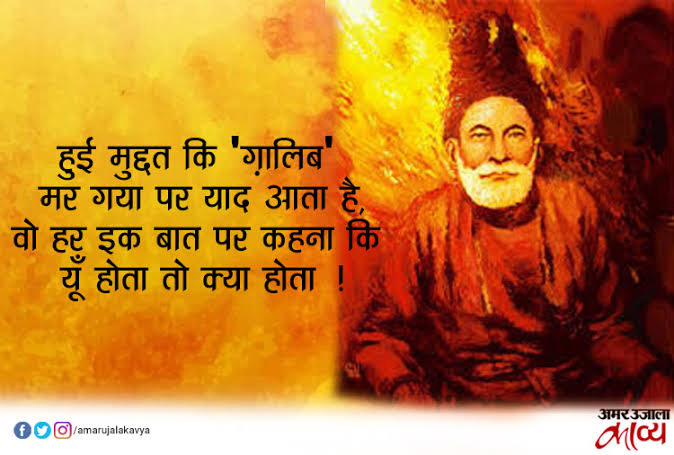
READING GHALIB IN THE TIMES OF CAA

Now that our democratically elected government has decided to use perfectly legal ways to destroy the idea of India, we must celebrate that idea in whatever time is left before it is flattened like the Bamiyan Buddha.

Muslims—orthodox, moderate, radical—are an inextricable part of the idea of India. You cannot conceive modern India without Muslims, without their multifarious contributions to the society, their sacrifices for the country, their service to the nation.

Mirza Ghalib (1797–1869), one of our greatest poets, an irreverent Muslim, and a genuine “Indian” (born before India took birth) occupies a central place in the idea of India.

This year we have 150th death anniversary of the great Urdu poet.

And, today, 27 December, is his birth anniversary.

Ghalib, arguably, perfected the Urdu tongue, which, thanks to Bollywood, has become the nation’s lingua franca.

One culturally illiterate MP of the ruling party had suggested that we must wipe out Urdu influences from the Bollywood movies and songs, and replace them with Sanskrit.

This may happen soon.

Reading Ghalib may soon be outlawed. (I hope I’m wrong.)

So while you can, read and enjoy Ghalib, who was born in Agra, and died in Delhi. But since his parents were born before 1987, he may soon be out of NRC. 

(Facebook post on 27.12.2019)


Wednesday, October 02, 2019

HOW TO KILL GANDHI

It would have been unimaginable a few years ago that 150th anniversary of the man considered Father of the Nation will also be almost the last nail in his coffin.

By 1947, Gandhi was the biggest symbol of communal harmony. On question of caste his position was contested, but he was the undisputed leader of Hindu–Muslim unity.

When a bullet from a misguided fanatic’s gun felled the frail mahatma, the nation consoled itself by saying that his ideas would outlive him and would be a “kindly light” for the newly formed country.

However, in 2014, the “government of Hindus was made after 800 years”. We stopped talking about Hindu–Muslim unity. But what do we do with Gandhi?

We emptied him out of any meaning he may have had for our times. Non-violence and Truth were outdated ideas in the era of mob lynching and fake news.

The only way to keep the Gandhi brand available for political gain was to make him a mascot of a national cleanliness drive—Swachh Bharat Abhiyan (Clean India Campaign)!

Gandhi for cleanliness drive? Sure!
Gandhi for communal harmony? No way!

Gandhian ideal of Hindu–Muslim unity was made irrelevant because we want to build a Hindu Rashtra. Gandhian idea of non-violence was abandoned because it was drawn from the Christian Bible (Sermon on the Mount). Gandhian idea of Truth was given up because power must be grabbed at any cost, even falsehood.

All that was left of Gandhi was photo ops for politicians sweeping the already swept streets. Or killing little children relieving themselves in the open.

A great man dies not when he stops breathing but when his memory is manipulated to suit our convenience. This is what is being done to Gandhi. Our current generation is growing up with Gandhi being a man who inspires us to pick up the broom—and not as someone who urges us to arm ourselves with weapons like truth and non-violence.

Gandhi has been like a proverbial snake that was killed while the stick remained intact.

Godse did not kill Gandhi. The current dispensation has killed him!

Wednesday, March 27, 2019

Chowkidar for the Caste-Corrupted Empire

A bullet train is no match for the speed with which our great political orators spit out catchwords to capture the nation’s imagination. The latest comes from our Prime Minister Sri Narendra Modi. He had earlier tried to convince the electorate that he was the only Übermensch who could protect their borders, their bank balance and their dharma. But after nearly five years—in which he coined innumerable new terms and renamed old schemes—he realized that he had not delivered as the chowkidar, the prime watchman of the nation. Lo and behold, he decided to share his failure with his entire constituency. Hence you have #MainBhiChowkidar trending on the social media. From cabinet ministers to former cow vigilantes, all have prefixed their social-media identities with the word, Chowkidar.

An incendiary Hindutva ideologue from his party, Sri Subramanian Swamy, refused to follow the fad. A former Harvard faculty member, he had sound reasons. In an interview given to a Tamil TV channel he said that being a Brahmin, he could not be a chowkidar. Brahmins, in the orthodox social hierarchy, are the priests and teachers. They instruct others and do not take orders a la doormatly doormen. In ancient times they had absolute control over knowledge, the classical language, and the sacred texts, while the rest of the populace was practically illiterate. Sri Swamy has made it clear to the prime minister that it is fine for an OBC (a Shudra, in the traditional hierarchy) like him to be the chowkidar, who would take orders from the citadel of Brahmanism in Nagpur. But Sri Swamy would not exchange his role as intellectual commander of the bahujans (majority-people, the so-called backward castes) for such sentimental reasons. 

After the 2014 general election, when Sri Narendra Modi was chosen to occupy the highest political office of the country as a democratically elected parliamentarian, there were many among even the so-called liberal-left anti-caste intellectuals who were filled with awe and praise for the RSS. They began to argue that unlike the secular parties, RSS seems to have given an OBC the chance to scale the political ladder and become the prime minister in a democratic manner. They believed it to be the sign that under RSS, the traditional caste system is being dismantled and a unitary and unified identity of a casteless Hindu is emerging, or, in fact, has emerged.  

But as the seemingly off-the-cuff remark by Sri Swamy shows, Brahmanism continues to pull the strings of even this stage-managed show of the casteless Hindu. The India that Sri Narendra Modi is a prime minister of is not the India of RSS’s dreams. This sovereign, socialist, secular democracy—this India that is Bharat, which is governed by a constitution guided by Western liberal and Christian principles, and has been drafted by a Dalit—is something they loathe. They are extremely uncomfortable with the Indian Tricolour, which they never hoist in their gatherings. Their ideal is a vast Hindu empire that holds almost the entire South Asia within ancient hierarchies of caste under a saffron flag. Until that happens, they must let a Shudra pawn consolidate India’s “backward” castes behind, ultimately, the Brahmin leadership. Accommodating one Modi is a small price to pay to win the allegiance of the entire backward communities of India. In a dark dystopian fashion, Sri Narendra Modi is a harbinger who will  do the dirty job of destroying democratic institutions and structure of India, till the “rightful owners” are back in power with all their Hindutva glory. 

Between Sri Modi’s call of letting the world know that we are fellow chowkidars with him and Sri Swami’s smug rejection of the same, a shocking news came out. It was in Sri Modi’s home state Gujarat. A 17-year-old Dalit student was allegedly tied to a tree, beaten up and was prevented to appear in the all-important board exams. The two attackers had apparently told him that since he was an untouchable “he should not study and take his exams but do labour work”. Later, it was also alleged that the boy was attacked because he was in a relationship with an upper-caste girl. In either case, the assaulters were trying to guard their caste status. After all, ye bhi chowkidar hain! (They too are watchmen). 

People are being deluded into thinking that by calling themselves chowkidar they are somehow fighting economic corruption. But can any of these swords-wielding sentinels do anything to prevent the kind of crimes committed by the likes of Nirav Modi, Lalit Modi and Vijay Mallya? Most of them won’t even challenge the corruption in their gram sabhas if the sarpanch is from their religion or caste. The chowkidars, like their previous cow-vigilante avatar, would target the Dalits and religious minorities. In this election season chowkidars will use the morally charged language to unleash terror among the political opponents. That’s where the whole chowkidar movement is leading to. Didn’t Sri Swamy once say that elections are not won on the basis of soundness of your economics, but how well you emotionally manipulate your cadre and the electorate? That seemingly off-the-cuff remark by him has deep roots in Hindutva ideology of brahmanical supremacy. And the foot soldiers, with the new name of chowkidars, would very willingly give their all to revive and protect the caste-ridden structure of the society. 

This is where the chowkidars will become their own gravediggers.

Tuesday, June 12, 2018

Why Saffron Brigade Hates Pandit Nehru

Pandit Jawaharlal Nehru practised yoga. Of course, he was a Kashmiri "pandit". Why does RSS, BJP, and the whole bhakta bandwagon hate him? One reason is that unlike the fanatics, he did not fantasize about an ideal "Hindu" past. For example, unlike a current BJP minister who said journalism began in the Mahabharata, Nehru acknowledged the pioneering role of Serampore missionaries, William Carey, Joshua Marshman and William Ward, in setting up free press in nineteenth-century India. Nehru was a reform-minded, moderate, educated Hindu who was sensible and humble enough to acknowledge historical debts. He did not try to paint Indian history with saffron-soaked brush. Here are some of his thoughts—culled from his masterly The Discovery of India—about the emergence of modern Indian mind. This will be of immense value to the younger generation
THE ROLE OF NON-STATE ENGLISH PLAYERS:
"Individual Englishmen, educationists, orientalists, journalists, missionaries, and others played an important part in bringing western culture to India, and in their attempts to do so often came into conflict with their own Government. That Government feared the effects of the spread if modern education and put many obstacles in is way, and yet it was due to the pioneering efforts of able and earnest Englishmen, who gathered enthusiastic groups of Indian students around them, that English thought and literature and political tradition were introduced to India." (Nehru 313).
INFLUENCE OF MISSIONARIES ON HUMANITARIAN ORGANISATIONS IN INDIA:
"Full of the ideal of the patient loving service of the Franciscans of old, and quiet unostentatious, efficient, rather like the Quakers, the members of the Ramakrishna Mission carry on their hospitals and educational establishments and engage in relief work, whenever any calamity occurs, all over India and even outside." (Nehru 315).
ON EMERGENCE OF MODERN PRESS IN INDIA:
"The first private printing press was started by the Baptist missionaries in Serampore, and the first newspaper was started by an Englishman in Calcutta in 1780. All these and other like changes crept in gradually, influencing the Indian mind and giving rise to the 'modern' consciousness." (Nehru 313).
"From 1780 onwards a number of newspapers had been published by Englishmen in India. These were usually very critical of the Government and led to conflict an the establishment of a strict censorship. Among the earliest champions of the freedom of the press in India were Englishmen and one of them, James Silk Buckingham, who is still remembered, was deported from the country. The first Indian owned and edited newspaper was issued (in English) in 1818, and in the same year the Baptist missionaries of Serampore brought out a Bengali monthly and a weekly. Newspapers and periodicals in English and the Indian languages followed in quick succession in Calcutta, Madras, and Bombay" (Nehru 316).
ON DEVELOPMENT OF MODERN INDIAN LANGUAGES:
"Serious writing was almost confined to Sanskrit and Persian, and every cultured person was supposed to know one of them. These two classical languages played a dominating role and prevented the growth of the popular provincial languages. The printing of books and newspapers broke the hold of the classics and immediately prose literatures in the provincial languages began to develop. The early Christian missionaries, especially of the Baptist mission at Serampore, helped in this process greatly. The first private printing presses were set up by them and their efforts to translate the Bible into prose versions of the Indian languages met with considerable success.
"There was no difficulty in dealing with the well-known and established languages, but the missionaries went further and tackled some of the minor and undeveloped languages and gave them shape and form, compiling grammars and dictionaries for them. They even laboured at the dialects of the primitive hill and forest tribes and reduced them to writing. The desire of the Christian missionaries to translate the Bible into every possible language thus resulted in the development of many Indian languages. Christian mission work in India has not always been admirable or praise-worthy, but in this respect, as well as in the collection of folklore, it has undoubtedly been of great service to India" (Nehru 317–318).
(Originally shared as an FB post on 31.05.2018)

Saturday, June 09, 2018

The Guiding Philosophy of NDA Government


You may remember the popular mind teaser where they ask you to make a line shorter without erasing it. Do you? You just needed to draw a bigger line! The present government has taken it as their guiding philosophy. In the last four years, the NDA government has created bigger problems, compared to which the former problems fade away. 

Four years ago, in 2014, we asked a question: How do we tackle rampant corruption in India? In the last four years, this question has conveniently been swept under the carpet. Instead a new question has been hurled at us: WHAT IS "INDIA"? The politicians and trolls, including the PM himself, have made it their point to persistently peel off our nation's skin to look for a true, real, genuine India, which according to them is nothing but another name for a particular religion. But they don't realise that while doing this, they have done great harm to the very soul of India. They have bruised it beyond recognition. 

The new India entered a gestation phase after the dissolution of the great Mughal Empire in the eighteenth century. It grew for 250 years in the womb of history's fluid yet defining influences, before being born as a nation in 1947. Last two hundred years have been the most influential, when two most important principles of civilised existence, namely freedom of conscience and education for all, became part of our cultural ideals. Those who lived on the margins of the great Indian civilisation began to crawl and toddle towards the centre. A new India began to stand on its feet. 

The flag bearers would love to throw the baby with the bath water. The problem is that baby is grown and would not be so easily thrown out. Not without a fight, even when bruised.

The trickery would be exposed one day. You can't keep committing bigger blunders to hide the previous imbecility.

(Originally a Facebook post, dated 08 June 2018)

Wednesday, April 11, 2018

Phule's "Tritya Ratna": A Tribute to Missionaries

In 1855, the 28-year-old Jotirao Phule of Poona wrote a Marathi play Tritya Ratna (Third Jewel). It was to be sent to a prize committee managed by the British government of the time. The committee had been set up to reward scholars’ accomplishment, which at that time were mostly Brahmins proficient in Sanskrit. Poona’s enlightened citizens had petitioned the government that it must also encourage original Marathi writing among the literati of the Bombay Presidency. The award was called Dakshina Prize.
The original Dakshina Prize had been instituted by the great Shivaji himself. It used to be given to the learned Brahmins who had mastered the Sanskrit religious texts. Later, Peshwa rulers of Maharashtra used it to strengthen their hold over the state power. Peshwa Baji Rao II (r. 1795–1818) reportedly gave Rs 1,00,000 as dakshina to fellow Chitpawan Brahmins.

The British defeated the Peshwas in 1818. As pragmatic rulers do, they continued most of the cultural and socio-religious practices inherited from the Peshwas. This included awarding of Dakshina. Traditionally that meant the gift to the Brahmin priest. The British knew that to perpetuate their rule in India, they must make concessions to the elite class from among their subjects. The support extended by the East India Company to temples, religious practices, rituals and customs of the Hindus led some historians to remark that the “Indian Empire [of the British] was, fundamentally if not formally, a Hindu Raj” (R. E. Frykenberg).

Lord Mountstuart Elphinstone, the governor of Bombay, continued the practice where only Brahmins were considered for Dakshina. He founded a Sanskrit college in Poona in 1821 and spent forty percent of the Dakshina amount there. However, in due course of time, he brought about two changes in this policy. First, he made it possible for non-Brahmins to apply for the prize. Second, he made works not only in Sanskrit but in Marathi to be considered for state support. At that time Marathi was just developing into a modern and respectable literary language. This happened because of the pioneering work done in the field of Marathi lexicography and grammar by missionaries such as William Carey.  He published the first Marathi grammar in 1805 and then a Marathi dictionary in 1810. Later, American and Scottish missionaries brought out number of school text books that prepared a new generation of Marathi readers and writers.

Elphinstone was not the only one interested in giving prizes to non-Brahmins. Reform-minded Brahmins such as Lokhitwadi Gopalrao Deshmukh also collected signatures to pressurise the government to give some of the Dakshina fund to Marathi works. These reformers, however, were threatened by the traditionalist Brahmins. In this case, Jotirao himself provided security to the petitioners.

Coming back to the play, we know that that play was never performed. Dakshina Prize Committee rejected the play. Why? In his most celebrated work Slavery (1873), Phule recounts: “…I had written a play to the Dakshina Prize Committee, too. This was way back in 1855. But even there, the opinions of the bhat [Brahmin] members held sway and the European officers could do nothing. So my play was straightaway rejected.”

The play tells the story of a rural couple. A farmer and his pregnant wife are exploited by the religious trickery of the local Brahmin priest. The shenanigans of the priest, his wife and extended family are laid bare in a great detail. The Vidushak in the play adds humour but also sheds light on the nature and extent of exploitation with his incisive remarks. Vidushak is the traditional drama narrator, often a mouthpiece of the author—and in this play he is the alter ego of Phule. The play concludes that, for the unlettered, “backward” villagers the way out from exploitation is through education. The farmer and his wife decide, by the end of the play, that they would go and enrol themselves in the night school of the Phules, and will create a new future for their unborn child.  

The curious thing about the play, however, is the presence of a Christian padre. During the latter part of the play, Phule makes this unnamed padre almost the central character. It is he who makes the first move to open the Tritya Ratna (Third Jewel or Eye) for this “low-caste” couple. Third jewel is a metaphor for critical, rational thought unrestrained by fear of the socially dominant classes. The jewel is more than mere literacy, or the mere ability to read and write. It is ability to interpret life and what it dishes out to you for yourself, without coercion or deception. The jewel, the proverbial third eye, is flowering of the intellect enthralled for ages by the mythologies and superstitions. It is the life-line for dignified living as a respectable human being.

Phule could have written his play without the padre. The plot for the play would be simple and effective. Lack of education leaves you prone to exploitation: get educated, escape exploitation. But by making a padre the catalyst for the true awakening within the individual as well as the society, Phule was underlining a historical reality. He was documenting a social truth. It was the Christian missionary who brought enlightenment and the knowledge of true God to the masses of India. Phule himself studied in the Scottish missionary school and it is very likely that he developed his own critical acumen and strengthened the courage to question the degrading caste system of India in the company of highly inspirational and dedicated teachers like Murray Mitchell (see Rosalind O’Hanlon).

Phule saw clearly that British had established their rule in Maharashtra with the help of the shetji-bhatji combine (moneylenders and priestly class). They would not risk their government by offending them. British rulers could not be seen as promoting the interests of the “lower castes”. Phule also saw that the only social force that worked for the genuine uplift of marginalized shudras-atishudras of Maharashtra was the missionaries.

Jotirao Phule is considered the first “Indian” to start a school of untouchable girls in 1848 in Poona. He was inspired by another such school he had seen in Ahmednagar the previous year, which was run by a woman missionary Mrs Farrar. Dhananjay Keer, Phule’s biographer tells us that, Phule and his friend Govande had been “impressed by the foreigners’ perseverance in improving [India] and felt for their [fellow]countrymen’s neglect for it”.

It can be said that Phule’s play was not only a battle cry for the education of Indian masses long neglected and exploited by the country’s elite but also a rich tribute to the pioneering and self-less work by unsung heroes of India’s regeneration—the Christian missionaries.

References

Frykenberg, Robert E. “Christian Missions and the Raj”. Mission and Empire, edited by Norman Ethrington, Oxford UP, 2008.
Keer, Dhananjay. Mahatma Jotirao Phooley: Father of the Indian Revolution. Popular Prakashan, 2005.
O’Hanlon, Rosalind. Caste, Conflict and Ideology: Mahatma Jotirao Phule and Low Caste Protest in Nineteenth-century Western India. Cambridge UP, 2002.

Friday, December 29, 2017

"Newton" Fell on My Head

YESTERDAY NEWTON FELL ON MY HEAD: My Musings on the Film's Ideas Including That of Human Equality

At one point, Loknath ji asks Newton Kumar about the source of his courage. "You must know a politician or some other big shot. Otherwise, how could you take on the police officials?" Of course, the source of courage that Newton Kumar, the presiding officer of a Dandakaranya election booth, had was his sense of duty. He wished to work honestly. He wished to work honestly in an environment that is clogged up with lies, indifference and make-believe.

But that is not all. Our personal sense of right and wrong is not the only thing that determines that we will choose the right thing. We choose the right thing also because we are inspired by some heroes. Who was Newton Kumar's Hero? Newton Kumar, a government officer from Dalit background, we know, is committed to the Indian Constitution, which in popular imagination is the brainchild of Dr B. R. Ambedkar. For a fleeting second, one could see that in Newton's room is hung a portrait of Dr Ambedkar.

But that again was not all.

We are inspired by ideas we believe to be true. Sometimes these philosophic ideas are bigger than heroes. The big idea that gave edge to Newton's resolve to be honest was an insight into the work of Isaac Newton, the apple-wala scientist! Nature is no respecter of people. Natural Laws are the same for all. ("You can throw a business tycoon and a tea seller from a cliff and both will meet the same fate!", says a senior officer) By implication, all are equal. The vote of every single individual is equal. That is why Newton Kumar is ready to put his life on  the line to make every single voter cast his or her vote.

The little problem is that nature does not always teach us equality. Nature, to many people, teaches "survival of the fittest". By the way, our social experience teaches us that it is much easier to throw a tea seller than a tycoon from the top of a cliff!

It may sound strange to most people but Isaac Newton, the scientist, was also a man of religion. He considered God, and not nature, the final arbiter of the question of human equality and dignity.

Human beings have dignity and they deserve to be treated equally because all of them are made in the image of their creator.

Last but not the least, the ability to give oneself a new name and new identity could be very empowering. Nutan is a beautiful name, but in the given context, Newton changed the life of the man. I am also reminded of the call by Professor #KanchaIlaiahShepherd to add English surnames to one's given names.

By the way do watch the film #Newton #NewtontheFilm. #RaghubirYadav as Loknath is masterful. It has moments of genuine comedy and leaves you feeling inspired. Stay back till the closing credits are over and enjoy Raghubir Yadav's song!

(FB Post/6.10.2017)

Tuesday, August 08, 2017

Anarkali of London: The Meek Shall Inherit the Earth

When I watched Anarkali of Arrah the other day on TV, my mind immediately went back to a novel about a young servant girl, poor and vulnerable, hounded by her lustful aristocrat master. The novel was written many, many years ago. Two hundred and seventy seven years ago, to be precise; yes, 227 years.  The novel became a literary sensation. Everybody was reading it, its success was unprecedented and astonished the literary circle! The novel was written by an unpretentious printer in London, a Puritan called Samuel Richardson—and the title of the novel was Pamela; or, Virtue Rewarded (1740).
I am not sure if the makers of the 2017 film had read the novel; incidentally, the film was based loosely on real-life incidents. In 2011, a folk singer was allegedly molested in public by a vice-chancellor of a university in Gaya in Bihar, and the former decided to take him on. When Richardson wrote his novel, he too fell back on a similar story he had heard about 25 years ago. To be fair, it’s not hard to search for these kind of incidents. Deprivation and depravity spawn hundreds of such stories around us.
But when turned into a book or a film why do they become such a rage. Why did 18th-century Londoners love Pamela? Many opined that its success may be attributed to purely voyeuristic reasons; the reader wants to know, will she surrender or not.  What graphic details could be expected to be there when she does give in? It’s the “vicarious sexual experience” that readers were looking for. However, the scholars agree that such stupendous success could not be ascribed to voyeurism alone. The readers saw that in the novel by not surrendering to the supremacy of her master, that “chit of a girl” had challenged the power relations of her society. More than that it was the triumph of the meek against the mighty that resonated with the public. Walter Allen, a historian of English novel, comments: “Against an almost omnipotent authority Richardson pitted helplessness combined with virtue – and despite all hazards, helplessness combined with virtue triumphed, simply because it was virtue, and what is more, forced authority to accept it on his own terms. It was this that the age applauded: Richardson was the spokesman of justice.”
It wasn’t sex, but justice that people craved for. Modern literature, especially the modern genre, the novel, centred on the lives, struggles and triumphs of people who had been on the margin of society. Their presence and representation in culture was marginal, too. Epics and tragedies, the classical forms of literature, would tell the tales and fortunes of high-born men—kings, warriors, demigods—pitted against the cosmic powers, but no epic could have been written about the inconsequential struggles of a hapless “Pamela”—a woman and social nobody. Why is her virtue so important—after
all, hundreds and thousands of servant girls had been sexually exploited by their masters throughout history. The reason lay in that post Reformation, the moral and intellectual climate of Europe had changed. Individualism and individual dignity, Reformation’s gift to the West, birthed a new intellectual climate in Europe and with it a new literary form, the novel. Incidentally, critics of this new low-brow literature deemed it fit on the ill-educated and women. But as Terry Eagleton tells us, “In the end, the English novel would wreak its vengeance on those who dismissed it as fit only for females by producing some magnificent portrayals of women. It also produced some distinguished female exponents of the craft.” World literature would never be the same. Cinema, the youngest narrative genre, has inherited the same moral framework.
Anarkali of Arrah, reaffirms that our apparently sex-crazy world pines for justice for the weak, justice for “helplessness with virtue”. In the end of the movie, we see the police commissioner getting ready to begin criminal proceeding against the vice-chancellor. The film, however, has a reformatory ending, the lonely VC breaks down, and one hopes these are tears of repentance. Anarkali is free to live her life, her way.

In the novel, Mr B., the prurient master, repents and honourably marries Pamela. Anarkali and Pamela could exchange places because 18th-century London and 21st-century Arrah are under one moral framework that says “Blessed are the meek for they shall inherit the earth”.

Saturday, June 24, 2017

Anita Desai Turns 80 Today

I was lately going over her first novel, Cry, the Peacock (No, it's got nothing to do with procreative prowess of the pheasant's tears). The protagonist longs to go to Darjeeling (No, it's got nothing to do with the Gorkha agitation; she wants to get away from oppressive Delhi summer).
It's a story of woman tormented by dominant philosophies of fate, detachment and male ego.
The novel was published in 1963, sixteen years after India's independence and gives an interesting insight into the psyche of the upper-upper-middle-class society (Delhi and Lucknow are the two key places) in those early years of our "young" nation.
There's a marital mismatch. Husband, a cerebral lawyer, is almost twice the age of his sensual wife. He wants to teach her detachment as found in the Gita; she, who has memorised a fair bit of the Gita herself, finds the doctrine of detachment absurd in the context of married relationship. And, that's the conflict, which has some dire consequences!
Desai has admitted in an interview that her earlier books are "overwritten". The imagery and symbolism in this novel is cloying—there is a glut, in fact. However, in terms of seeking answer to some philosophic questions, it is an honest book.
A few quotes from the book:
"Trains passing in the night, I cannot bear to hear them. They all leave me behind alone."
"It is the evening that break one's heart. At night one only hears the pieces falling."
The one I think was quite clever is this. She has just opened a tap...
"It gurgled in hesitation, then spat, and the water came burbling out, laughing at my surprise."
Happy birthday and God bless, Ms Desai!

Saturday, April 29, 2017

Golden Age of Indian Nation Is Yet to Come

In a recent op-ed in a national daily, Dr Rakesh Sinha, a Delhi University professor, sought to clear the mist around the Rashtriya Swayamsevak Sangh’s idea of cultural nationalism, and rescue it from the attacks of the critics, whom he caricaturises as pseudo-secularists. But in doing so, the writer, first of all, misread what a renowned political scientist has said about modern nations.

Image courtsey: apsc-arts.deviantart.com
Late Benedict Anderson, a Cornell University professor had stated in his 1983 book that modern nations are best understood as imagined communities (also the title of the book) because, to quote him, “the members of even the smallest nation will never know most of their fellow-members, meet them, or even hear of them, yet in the minds of each lives the image of their communion.” Dr Sinha asserts that the RSS’ idea of Hindu rashtra “disqualifies Benedict Anderson’s concept of nation as an ‘imagined community’”. It is difficult to understand why it should be. The probable explanation is that an imagined community seeks participation from its citizens in creating a common culture, while the state in the Hindu rashtra is busy ensuring that Muslims, Christians or communists as well as the Dalits and adivasis are falling in line with the Hindutva ideal of cultural “unity”. Dr Sinha is well within his rights to bring forth the magnanimity of Sri Golwalkar with regard to cow protection and Muslim baiting but hero worship must not blind him to what the second sarsanghchalak had said in his Bunch of Thoughts. Similarly, even though Anderson is no apologist for nation or nationalism, for the sake of intellectual honesty, a gross misreading of him must be avoided.

By “imagined” Anderson does not mean “unreal”, “false” or “artificial”, it merely notices that in modern times people all over the world have creatively visualized and shaped, i.e., imagine, their collective and distinct existence as a nation. He says, “Communities are to be distinguished, not by their falsity/genuineness, but by the style in which they are imagined.” In India, Hindus, Muslims, Christians, Sikhs, Buddhists, animists, atheists all must come together to imagine how we would like to live. However, Dr Sinha would like us to believe that the final word about Indian nationalism had been spoken; we only now have to impose it without any further attempt at dialogue.

Ernest Renan, the nineteenth-century scholar in whom RSS ideologues might discover a kindred spirit, made a valid point when he said there are two things that constitute the nation: “One is in the past, the other in the present. One is the common possession of a rich heritage of memories; the other is the actual consent, the desire to live together, the will to preserve worthily the undivided inheritance which has been handed down.” While Hindutva organizations and ideologues go hammer and tongs about the former, they exhibit a glorious disregard of the need to engage with others in a dialogue to collectively shape a common future.

And the above are not the only failures of the Hindutva movement.

The insistence on the so-called “cultural nationalism” and the talk of “civilizational trajectories” proffer an extremely narrow view of Indian history. Scholars call it an essentialist view; we might even refer to it as the fossilized image of India’s past. Modern India has moved far ahead from the “golden period” first popularised by the European Indologists of eighteenth and nineteenth centuries. The upper-caste Hindu intellectuals took advantage of the scholarly discoveries of the Indologists and fashioned the language of modern Indian nationalism. This new language was in essence patently brahmanical—eulogizing, at different times and in different regions, cow, Ganesha, Krishna, Gita, mother goddess, temple, so on and so forth. But it excluded the contrapuntal contribution of many other Indians who at that moment were just beginning their exciting journey in articulating their points of view. Universal education, political mobilization, participation of women, has now made it possible for a truly representative majority of Indians to engage in a fruitful conversation about the meaning and essence of Indian nationalism. If ever there was “golden period” in Indian history, it is now; but, by harping on Hindu Rashtra, Dr Sinha—and the movement he represents—is missing a golden opportunity to create a genuine Indian nationalism and a genuine Indian nation.

Sunday, April 09, 2017

Disillusioned Bhaktas: Barbaric Times, Not Good Days, Ahead

Tavleen Singh (Image: Indian Express)
Senior journalist Ms Tavleen Singh was, and is, seeking Hindu renaissance but so far all she's got is gau rakshaks (cow vigilantes) on a terror spree—harassing, beating, killing Indian citizens in the name of protecting cows, considered holy by Hindus.

In her latest Indian Express column (“Is This Hindutva?”, 9 April 2017), Ms Singh has lamented that India no longer seems to have “Rule of Law”. Exasperated over the recent lynching of a Muslim dairy farmer from Haryana, she writes:
"A man was beaten to death in a manner that reminded everyone of earlier barbaric times when there was no rule of law."
And again:
"This is not about cows and cow slaughter. It is not even about Hindus and Muslims even if the killers were Hindu and the victims Muslim. This is about whether India is a country in which there is the rule of law or not."
For a long time, week after week, Ms Singh used her mightier-than-sword pen to advance the saffron juggernaut. Every Sunday, she tried to convince her readers that the rise of the home-grown fascists is good for the country. What made her, a foremost English-language journalist, a non-card-carrying member of the Hindutva brigade? To understand that we must pay attention to her peculiar intellectual journey.

Coming from a privileged background, Ms Singh received best of education in some of the elite educational institutions. But modern, Western education had an alienating effect on her. She opens the preface of her 2012 book Durbar with this sentence: “When I was sixteen years old I first became aware of being a foreigner in my own country.” She goes on to explain that the elite classes who eventually ruled India since Independence have been too Westernised and did not have any deep understanding or appreciation of  their own country. She says further in that Author’s Note: “I would go so far as to say that my generation of Indians was possibly more colonized than those who lived in colonial times and out tragedy was that most of us lived out our lives without ever finding out.”

Ms Tavleen Singh is, thus, on a mission—the mission to decolonize India’s ruling elite. Sadly, she saw the ruling elite only in the Westernised upper class and not in the brahminic revivalists. To defeat the former she put her trust in the latter. To help vanquish the dynastic disease in Indian politics, she put her trust in the communal poison—only that the cure proved to be worse than the disease. Hence, Ms Singh who rightly abhorred the rule of dynasty, now rues the demolition of the rule of law.

By the end of that preface, Ms Singh is pining for an “Indian renaissance”, which in today’s column she calls “Hindu renaissance”, and which she assumes has been held captive by the Westernised ruling classes. Five years later Ms Singh, in disillusionment, writes: “No renaissance can ever come from this [horrible violence in the name of the cow].”

This perhaps is the fate of all our modern-educated, elite supporters of the brazenly Hindu nationalist party.

Arun Shourie (Image: Indian Express)
Nearly a quarter of a century ago, another top journalist of India, Mr Arun Shourie attempted decolonization of the Indian mind by an unfair attack on the missionary movement of the nineteenth and twentieth century in India. In his 1994 book, Missionaries in India: Continuities, Changes, Dilemmas, Mr Shourie had rehashed the popular myth that missionary movement was the handmaiden of British imperialism.

Vishal Mangalwadi, an Indian Christian writer and activist, began to write letters to Shourie responding to many of his allegations. However, as Mangalwadi points out the real problem with Shourie’s book wasn’t the calumny or attack or bitterness, but a certain way of presenting history.

Mangalwadi rightly points out that in the true postmodern (pre-modern brahmanic) fashion, Shourie had already made up his mind as to what he wanted to say and then used the evidence in a selective way to prove his prejudice. While closing his last letter, Mangalwadi had an important observation to make. He wrote:
"Let me conclude: it does not disturb me greatly if you write untruth concerning missions and the missionary motive. The bigger problem is that you are promoting a relativism which assumes that nothing really true can be known; this means (whether you acknowledge it or not) that everything is relatively false. In this setting, truth is whatever suits me at this moment. … I understand, Mr. Shourie, your intellectual compulsions behind accepting a worldview of half-lies. But I am sad that you do not seem to have thought through the long term implication of this position. To begin with, your commitment to relative falsehood will undermine your credibility as a writer. You will, no doubt, still be useful to one or other interest group … however, the community as a whole can be blessed only by rigorous commitment to Truth."
By promoting half-truths and utter lies, Mr Shourie, has helped create an atmosphere in India where today people, especially on social media, are not interested in honest, truthful debate but getting their point—or prejudice—proved. If they don’t have facts to back themselves, they resort to shouting, abusing and threats of physical violence. Mr Shourie himself has been a victim of the viciousness of Internet trolls. And, why only Internet trolls, election campaigns are run on lies in this post-truth era.

When the elite of any culture is driven not by truth but by a misplaced sense of prestige and pride, it does irreparable harm to the society. It strengthens the forces that eventually shatter their own cherished dreams.

What both Singh and Shourie's experience tells us is that their reading of their own history is erroneous and their solutions to India’s problems will be nothing but catastrophic.

Monday, January 30, 2017

A Call for Good Samaritans!


Ministers of all faiths, tomorrow you should get in your pulpit with the Christian Bible and preach on Luke 10:25-37”.


By tweeting thus, American author Stephen King has made a seemingly astounding claim. He has clearly said that the parable of the Good Samaritan must be restated and reaffirmed as the foundational moral framework for our current world civilization, which is beset by intolerance, insanity and a marvelous lack of concern for the suffering.

This parable, originally told by Jesus to his interlocutors nearly two thousand years ago, has gone on to have a definitive impact on the social ethics of a multicultural, multiracial world.  

In the parable, Jesus was addressing the question: “Who is my neighbour?” The learned fellow Jews wanted clarity on what Jesus had just said: “Love your neighbour.” What followed is too well known to need repetition. But in this post-truth world, one must restate the obvious.

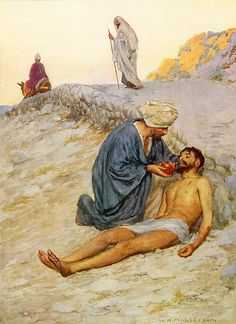
Jesus told his interlocutors about a man who was robbed on a highway and was left wounded and naked, waiting for a slow death in the wilderness. A couple of priests, one after the other, happened to go past their countryman. They chose to ignore him. It was a man from the neighbouring Samaria, apparently a trader, who had compassion on the wounded Jew, gave him first aid, got him into a room in an inn, paid for it, and promised to check on him on his way back.

The now bashful interlocutors had no option but to concede that the true neighbourly love was
expressed not by the pious and proud fellow countrymen but by a despised foreigner.

The impact of this parable must have been astounding. Jews and Samaritans were nationally and racially opposed to each other. The territorial and religious boundaries were always a source of controversy and conflict. Jesus with this simple parable, dealt a death blow to the notions of national and racial superiority. It struck at the very heart of ethnocentricism of Jesus’s audience.

Compassion for the foreigner, for the stranger, was inoculated into the DNA of our civilizational existence on that day. The parable told in an insignificant Middle-Eastern city colonised by the imperial Rome, went on to established its reign in the hearts and minds of men and women in the West and also in the East.

From proto-fiction to world literature

 The Good Samaritan by W. Hogarth, Fielding's friend
For hundreds of years this parable, the morally binding tale of compassion as duty, was repeated from the pulpits every other weekend. Rural folk got drunk on it. Kings and rulers were challenged by it. Through this fictional but plausible account, generations were initiated into the barbarity and beauty they would encounter in the world. The narrative potential of this proto-humanist fiction was immense. Novelists used it to critique hypocrisy of their societies. Henry Fielding, the pioneering English novelist of the eighteenth century, for example, deploys it in his novel Joseph Andrews (1742) to just that effect. The poor protagonist is wounded by robbers and is left to die on the road side. Respectable people initially refuse helping him. The poor postilion shares his coat with him. Class, charity, law, fear, compassion, all elements of great fiction are embodied in this incident.

And, it has to be more than a coincidence that this trope occurs in other literatures of the world.

In the first Tamil novel, written by Samuel Vedanayagam Pillai, Prathapa Mudaliar Charithram (1879), the protagonist’s grandfather, a Hindu, helps an injured Muslim “fakir”. While the others from his village avoid touching him for fear of ostracism, Prathapa’s grandfather “felt that it was his duty to help anyone in danger”.  

In the first Punjabi novel, Sundari (1897) by Bhai Vir Singh, the eponymous Sikh protagonist, helps, not once but twice, injured and abandoned Muslims—albeit with tragic consequences.

In Rabindranath Tagore’s Gora (1910), Hindu parents of Gora too render help to a dying Irish soldier.

Pakistan’s Urdu writer Abdullah Hussain includes such incidence, which has considerable bearing on the plot, in his most important novel The Weary Generations (1999; Udas Naslain, 1963). 

Better-read people could add to this list. The underlying idea is that helping the helpless could alter our histories and the moral direction of our society. This story must be told and retold in as many forms as possible. It fascinated our novelists and writers through the years. It fascinates anyone who wishes to make sense of our world, who wants to find answer to the question: How should we live in a world bereft of compassion and civility?

Stephen King, the novelist, knows that there is no other place where he could find answer to this question except in Luke 10:25–37. 

This was the question that Jesus’s audience wanted to find an answer to. They asked what the greatest commandment was. Jesus’s answer was twofold: Love God with all your heart, with all your soul, with your strength and with all your mind and love your neighbour as yourself.

This is the question, incidentally, we Indians are seeking an answer to, especially since the "Nirbhaya" incident of December 2012. And, perhaps even before that, since 1971, since 1947!

Sunday, July 03, 2016

What’s Not in a Name?

Prof. Kancha Ilaiah’s insistence on using English surnames must be taken seriously by those who wish to create an egalitarian nation

Noted author and public intellectual, Prof. Kancha Ilaiah, formerly professor of political science in Osmania University, Hyderabad, in a recent article on a news portal announced that he has changed his name. He shall now be known as Kancha Ilaiah “Shepherd”, the addition signifying his traditional caste and family occupation.

Professor Kancha Ilaiah Shepherd
Image: lifesuccess.com
Some might dismiss it as a gimmick, but Prof. Ilaiah Shepherd sees this as a crucial move in his battle against the behemoth of caste in India. This is not an entirely new strategy. In the 19th century, Savitribai Phule advocated English language for social emancipation of India’s lowered castes. The chorus has only swelled in our 21st century. However, Prof. Shepherd is unique in asking English to be made part of one’s identity and not just an added skill set in “languages known” column of one’s résumé. 

Castes and names in India have been almost synonymous. If someone insists on knowing your full name, be sure he or she wants to know what caste you belong to. It may even determine how we treat our colleagues, neighbours, fellow students, clients, etc., etc. In short, it shapes our attitude towards fellow countrymen.

In a highly graded culture that we have in India, giving a name to a child is meant to fix his position in social hierarchy. I once heard an elderly anti-caste activist from Rajasthan explaining to a group the unwritten rules of the ancient system of Indian christening. His description was more colourful than the turban he was wearing. In his inimitable Rajasthani accent he explained how a Brahmin’s son would be called Vidyapati, Gyanendrapati, Saraswatichandra—names depicting his relation with
A Rajasthani Turban. Image: wikinut.com
knowledge and education. A Kshatriya boy would be called Randhir Singh or Ranvijay or Veer Pratap signifying the qualities of a warrior. A Baniya child would be called Dhanpat, Lakshmichandra, etc.; names that tie him to earning of wealth and riches. When a Shudra father takes his son to the village priest, the latter would ask, “When was this little imp born?” “On Buddhwar, Wednesday, sir,” the father would reply with his hands folded. “Name him buddhu (stupid), what else?” the priest would be grinning. So boys born on Monday would be Somus, those born on Tuesday would be Manglus, and so on.

The direction in which Prof. Shepherd is going seems to suggest that it is not enough for a Shudra or an outcaste father to rename his son Someshwar or Manglesh or Buddhadev and thus move up the ladder in the hierarchical Sanskritic tradition. He is asking such fathers to take pride in their own identities as manual labourers and learn from the Western counterparts where surnames like Smiths and Potters are no longer looked down upon. As a matter of fact, no one notices them or reads anything into them.

Prof. Shepherd opens himself to a lot of criticism from all quarters—even from sympathetic colleagues. Many would say that he is giving undue importance to the power of English language to bring emancipation to India’s lowered castes. They would argue that imposition of English by British colonialists is the root of all social evil we have in today’s India. But no one could deny the power of this pragmatic stance of Prof. Ilaiah Shepherd’s. Any person who could steer away from the identity imposed on him or her by the Sanskritic tradition does become the master of his or her individuality. And, no one can deny that the ability to fluently use English language does give one the social recognition that was denied him or her for generations.

However, Prof. Shepherd’s advocacy of English names and English language is not merely posturing or even some practical strategy. Behind his seemingly quixotic vision is the profound cultural understanding.  Languages in any culture are not merely means of communication, but also repository of cultural capital. They not only help us communicate, but make available to us all the philosophic and spiritual resources contained in that language. Prof. Ilaiah Shepherd wants us to look beyond Sanskritic traditions to forge a national identity.


In calling the lowered castes of India to add new English surnames to their given names, Prof. Kancha Ilaiah Shepherd is changing the terms of discourse. He is introducing the new “language” that we urgently need to discuss our existence and future as a nation. The name calling that we saw in recent times in the name of nationalism can be countered rather effectively, it seems, by a change in name.