Saturday, June 24, 2017

Anita Desai Turns 80 Today

I was lately going over her first novel, Cry, the Peacock (No, it's got nothing to do with procreative prowess of the pheasant's tears). The protagonist longs to go to Darjeeling (No, it's got nothing to do with the Gorkha agitation; she wants to get away from oppressive Delhi summer).
It's a story of woman tormented by dominant philosophies of fate, detachment and male ego.
The novel was published in 1963, sixteen years after India's independence and gives an interesting insight into the psyche of the upper-upper-middle-class society (Delhi and Lucknow are the two key places) in those early years of our "young" nation.
There's a marital mismatch. Husband, a cerebral lawyer, is almost twice the age of his sensual wife. He wants to teach her detachment as found in the Gita; she, who has memorised a fair bit of the Gita herself, finds the doctrine of detachment absurd in the context of married relationship. And, that's the conflict, which has some dire consequences!
Desai has admitted in an interview that her earlier books are "overwritten". The imagery and symbolism in this novel is cloying—there is a glut, in fact. However, in terms of seeking answer to some philosophic questions, it is an honest book.
A few quotes from the book:
"Trains passing in the night, I cannot bear to hear them. They all leave me behind alone."
"It is the evening that break one's heart. At night one only hears the pieces falling."
The one I think was quite clever is this. She has just opened a tap...
"It gurgled in hesitation, then spat, and the water came burbling out, laughing at my surprise."
Happy birthday and God bless, Ms Desai!

Saturday, April 29, 2017

Golden Age of Indian Nation Is Yet to Come

In a recent op-ed in a national daily, Dr Rakesh Sinha, a Delhi University professor, sought to clear the mist around the Rashtriya Swayamsevak Sangh’s idea of cultural nationalism, and rescue it from the attacks of the critics, whom he caricaturises as pseudo-secularists. But in doing so, the writer, first of all, misread what a renowned political scientist has said about modern nations.

Image courtsey: apsc-arts.deviantart.com
Late Benedict Anderson, a Cornell University professor had stated in his 1983 book that modern nations are best understood as imagined communities (also the title of the book) because, to quote him, “the members of even the smallest nation will never know most of their fellow-members, meet them, or even hear of them, yet in the minds of each lives the image of their communion.” Dr Sinha asserts that the RSS’ idea of Hindu rashtra “disqualifies Benedict Anderson’s concept of nation as an ‘imagined community’”. It is difficult to understand why it should be. The probable explanation is that an imagined community seeks participation from its citizens in creating a common culture, while the state in the Hindu rashtra is busy ensuring that Muslims, Christians or communists as well as the Dalits and adivasis are falling in line with the Hindutva ideal of cultural “unity”. Dr Sinha is well within his rights to bring forth the magnanimity of Sri Golwalkar with regard to cow protection and Muslim baiting but hero worship must not blind him to what the second sarsanghchalak had said in his Bunch of Thoughts. Similarly, even though Anderson is no apologist for nation or nationalism, for the sake of intellectual honesty, a gross misreading of him must be avoided.

By “imagined” Anderson does not mean “unreal”, “false” or “artificial”, it merely notices that in modern times people all over the world have creatively visualized and shaped, i.e., imagine, their collective and distinct existence as a nation. He says, “Communities are to be distinguished, not by their falsity/genuineness, but by the style in which they are imagined.” In India, Hindus, Muslims, Christians, Sikhs, Buddhists, animists, atheists all must come together to imagine how we would like to live. However, Dr Sinha would like us to believe that the final word about Indian nationalism had been spoken; we only now have to impose it without any further attempt at dialogue.

Ernest Renan, the nineteenth-century scholar in whom RSS ideologues might discover a kindred spirit, made a valid point when he said there are two things that constitute the nation: “One is in the past, the other in the present. One is the common possession of a rich heritage of memories; the other is the actual consent, the desire to live together, the will to preserve worthily the undivided inheritance which has been handed down.” While Hindutva organizations and ideologues go hammer and tongs about the former, they exhibit a glorious disregard of the need to engage with others in a dialogue to collectively shape a common future.

And the above are not the only failures of the Hindutva movement.

The insistence on the so-called “cultural nationalism” and the talk of “civilizational trajectories” proffer an extremely narrow view of Indian history. Scholars call it an essentialist view; we might even refer to it as the fossilized image of India’s past. Modern India has moved far ahead from the “golden period” first popularised by the European Indologists of eighteenth and nineteenth centuries. The upper-caste Hindu intellectuals took advantage of the scholarly discoveries of the Indologists and fashioned the language of modern Indian nationalism. This new language was in essence patently brahmanical—eulogizing, at different times and in different regions, cow, Ganesha, Krishna, Gita, mother goddess, temple, so on and so forth. But it excluded the contrapuntal contribution of many other Indians who at that moment were just beginning their exciting journey in articulating their points of view. Universal education, political mobilization, participation of women, has now made it possible for a truly representative majority of Indians to engage in a fruitful conversation about the meaning and essence of Indian nationalism. If ever there was “golden period” in Indian history, it is now; but, by harping on Hindu Rashtra, Dr Sinha—and the movement he represents—is missing a golden opportunity to create a genuine Indian nationalism and a genuine Indian nation.

Sunday, April 09, 2017

Disillusioned Bhaktas: Barbaric Times, Not Good Days, Ahead

Tavleen Singh (Image: Indian Express)
Senior journalist Ms Tavleen Singh was, and is, seeking Hindu renaissance but so far all she's got is gau rakshaks (cow vigilantes) on a terror spree—harassing, beating, killing Indian citizens in the name of protecting cows, considered holy by Hindus.

In her latest Indian Express column (“Is This Hindutva?”, 9 April 2017), Ms Singh has lamented that India no longer seems to have “Rule of Law”. Exasperated over the recent lynching of a Muslim dairy farmer from Haryana, she writes:
"A man was beaten to death in a manner that reminded everyone of earlier barbaric times when there was no rule of law."
And again:
"This is not about cows and cow slaughter. It is not even about Hindus and Muslims even if the killers were Hindu and the victims Muslim. This is about whether India is a country in which there is the rule of law or not."
For a long time, week after week, Ms Singh used her mightier-than-sword pen to advance the saffron juggernaut. Every Sunday, she tried to convince her readers that the rise of the home-grown fascists is good for the country. What made her, a foremost English-language journalist, a non-card-carrying member of the Hindutva brigade? To understand that we must pay attention to her peculiar intellectual journey.

Coming from a privileged background, Ms Singh received best of education in some of the elite educational institutions. But modern, Western education had an alienating effect on her. She opens the preface of her 2012 book Durbar with this sentence: “When I was sixteen years old I first became aware of being a foreigner in my own country.” She goes on to explain that the elite classes who eventually ruled India since Independence have been too Westernised and did not have any deep understanding or appreciation of  their own country. She says further in that Author’s Note: “I would go so far as to say that my generation of Indians was possibly more colonized than those who lived in colonial times and out tragedy was that most of us lived out our lives without ever finding out.”

Ms Tavleen Singh is, thus, on a mission—the mission to decolonize India’s ruling elite. Sadly, she saw the ruling elite only in the Westernised upper class and not in the brahminic revivalists. To defeat the former she put her trust in the latter. To help vanquish the dynastic disease in Indian politics, she put her trust in the communal poison—only that the cure proved to be worse than the disease. Hence, Ms Singh who rightly abhorred the rule of dynasty, now rues the demolition of the rule of law.

By the end of that preface, Ms Singh is pining for an “Indian renaissance”, which in today’s column she calls “Hindu renaissance”, and which she assumes has been held captive by the Westernised ruling classes. Five years later Ms Singh, in disillusionment, writes: “No renaissance can ever come from this [horrible violence in the name of the cow].”

This perhaps is the fate of all our modern-educated, elite supporters of the brazenly Hindu nationalist party.

Arun Shourie (Image: Indian Express)
Nearly a quarter of a century ago, another top journalist of India, Mr Arun Shourie attempted decolonization of the Indian mind by an unfair attack on the missionary movement of the nineteenth and twentieth century in India. In his 1994 book, Missionaries in India: Continuities, Changes, Dilemmas, Mr Shourie had rehashed the popular myth that missionary movement was the handmaiden of British imperialism.

Vishal Mangalwadi, an Indian Christian writer and activist, began to write letters to Shourie responding to many of his allegations. However, as Mangalwadi points out the real problem with Shourie’s book wasn’t the calumny or attack or bitterness, but a certain way of presenting history.

Mangalwadi rightly points out that in the true postmodern (pre-modern brahmanic) fashion, Shourie had already made up his mind as to what he wanted to say and then used the evidence in a selective way to prove his prejudice. While closing his last letter, Mangalwadi had an important observation to make. He wrote:
"Let me conclude: it does not disturb me greatly if you write untruth concerning missions and the missionary motive. The bigger problem is that you are promoting a relativism which assumes that nothing really true can be known; this means (whether you acknowledge it or not) that everything is relatively false. In this setting, truth is whatever suits me at this moment. … I understand, Mr. Shourie, your intellectual compulsions behind accepting a worldview of half-lies. But I am sad that you do not seem to have thought through the long term implication of this position. To begin with, your commitment to relative falsehood will undermine your credibility as a writer. You will, no doubt, still be useful to one or other interest group … however, the community as a whole can be blessed only by rigorous commitment to Truth."
By promoting half-truths and utter lies, Mr Shourie, has helped create an atmosphere in India where today people, especially on social media, are not interested in honest, truthful debate but getting their point—or prejudice—proved. If they don’t have facts to back themselves, they resort to shouting, abusing and threats of physical violence. Mr Shourie himself has been a victim of the viciousness of Internet trolls. And, why only Internet trolls, election campaigns are run on lies in this post-truth era.

When the elite of any culture is driven not by truth but by a misplaced sense of prestige and pride, it does irreparable harm to the society. It strengthens the forces that eventually shatter their own cherished dreams.

What both Singh and Shourie's experience tells us is that their reading of their own history is erroneous and their solutions to India’s problems will be nothing but catastrophic.

Monday, January 30, 2017

A Call for Good Samaritans!


Ministers of all faiths, tomorrow you should get in your pulpit with the Christian Bible and preach on Luke 10:25-37”.


By tweeting thus, American author Stephen King has made a seemingly astounding claim. He has clearly said that the parable of the Good Samaritan must be restated and reaffirmed as the foundational moral framework for our current world civilization, which is beset by intolerance, insanity and a marvelous lack of concern for the suffering.

This parable, originally told by Jesus to his interlocutors nearly two thousand years ago, has gone on to have a definitive impact on the social ethics of a multicultural, multiracial world.  

In the parable, Jesus was addressing the question: “Who is my neighbour?” The learned fellow Jews wanted clarity on what Jesus had just said: “Love your neighbour.” What followed is too well known to need repetition. But in this post-truth world, one must restate the obvious.

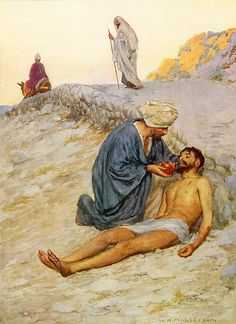
Jesus told his interlocutors about a man who was robbed on a highway and was left wounded and naked, waiting for a slow death in the wilderness. A couple of priests, one after the other, happened to go past their countryman. They chose to ignore him. It was a man from the neighbouring Samaria, apparently a trader, who had compassion on the wounded Jew, gave him first aid, got him into a room in an inn, paid for it, and promised to check on him on his way back.

The now bashful interlocutors had no option but to concede that the true neighbourly love was
expressed not by the pious and proud fellow countrymen but by a despised foreigner.

The impact of this parable must have been astounding. Jews and Samaritans were nationally and racially opposed to each other. The territorial and religious boundaries were always a source of controversy and conflict. Jesus with this simple parable, dealt a death blow to the notions of national and racial superiority. It struck at the very heart of ethnocentricism of Jesus’s audience.

Compassion for the foreigner, for the stranger, was inoculated into the DNA of our civilizational existence on that day. The parable told in an insignificant Middle-Eastern city colonised by the imperial Rome, went on to established its reign in the hearts and minds of men and women in the West and also in the East.

From proto-fiction to world literature

 The Good Samaritan by W. Hogarth, Fielding's friend
For hundreds of years this parable, the morally binding tale of compassion as duty, was repeated from the pulpits every other weekend. Rural folk got drunk on it. Kings and rulers were challenged by it. Through this fictional but plausible account, generations were initiated into the barbarity and beauty they would encounter in the world. The narrative potential of this proto-humanist fiction was immense. Novelists used it to critique hypocrisy of their societies. Henry Fielding, the pioneering English novelist of the eighteenth century, for example, deploys it in his novel Joseph Andrews (1742) to just that effect. The poor protagonist is wounded by robbers and is left to die on the road side. Respectable people initially refuse helping him. The poor postilion shares his coat with him. Class, charity, law, fear, compassion, all elements of great fiction are embodied in this incident.

And, it has to be more than a coincidence that this trope occurs in other literatures of the world.

In the first Tamil novel, written by Samuel Vedanayagam Pillai, Prathapa Mudaliar Charithram (1879), the protagonist’s grandfather, a Hindu, helps an injured Muslim “fakir”. While the others from his village avoid touching him for fear of ostracism, Prathapa’s grandfather “felt that it was his duty to help anyone in danger”.  

In the first Punjabi novel, Sundari (1897) by Bhai Vir Singh, the eponymous Sikh protagonist, helps, not once but twice, injured and abandoned Muslims—albeit with tragic consequences.

In Rabindranath Tagore’s Gora (1910), Hindu parents of Gora too render help to a dying Irish soldier.

Pakistan’s Urdu writer Abdullah Hussain includes such incidence, which has considerable bearing on the plot, in his most important novel The Weary Generations (1999; Udas Naslain, 1963). 

Better-read people could add to this list. The underlying idea is that helping the helpless could alter our histories and the moral direction of our society. This story must be told and retold in as many forms as possible. It fascinated our novelists and writers through the years. It fascinates anyone who wishes to make sense of our world, who wants to find answer to the question: How should we live in a world bereft of compassion and civility?

Stephen King, the novelist, knows that there is no other place where he could find answer to this question except in Luke 10:25–37. 

This was the question that Jesus’s audience wanted to find an answer to. They asked what the greatest commandment was. Jesus’s answer was twofold: Love God with all your heart, with all your soul, with your strength and with all your mind and love your neighbour as yourself.

This is the question, incidentally, we Indians are seeking an answer to, especially since the "Nirbhaya" incident of December 2012. And, perhaps even before that, since 1971, since 1947!

Sunday, July 03, 2016

What’s Not in a Name?

Prof. Kancha Ilaiah’s insistence on using English surnames must be taken seriously by those who wish to create an egalitarian nation

Noted author and public intellectual, Prof. Kancha Ilaiah, formerly professor of political science in Osmania University, Hyderabad, in a recent article on a news portal announced that he has changed his name. He shall now be known as Kancha Ilaiah “Shepherd”, the addition signifying his traditional caste and family occupation.

Professor Kancha Ilaiah Shepherd
Image: lifesuccess.com
Some might dismiss it as a gimmick, but Prof. Ilaiah Shepherd sees this as a crucial move in his battle against the behemoth of caste in India. This is not an entirely new strategy. In the 19th century, Savitribai Phule advocated English language for social emancipation of India’s lowered castes. The chorus has only swelled in our 21st century. However, Prof. Shepherd is unique in asking English to be made part of one’s identity and not just an added skill set in “languages known” column of one’s résumé. 

Castes and names in India have been almost synonymous. If someone insists on knowing your full name, be sure he or she wants to know what caste you belong to. It may even determine how we treat our colleagues, neighbours, fellow students, clients, etc., etc. In short, it shapes our attitude towards fellow countrymen.

In a highly graded culture that we have in India, giving a name to a child is meant to fix his position in social hierarchy. I once heard an elderly anti-caste activist from Rajasthan explaining to a group the unwritten rules of the ancient system of Indian christening. His description was more colourful than the turban he was wearing. In his inimitable Rajasthani accent he explained how a Brahmin’s son would be called Vidyapati, Gyanendrapati, Saraswatichandra—names depicting his relation with
A Rajasthani Turban. Image: wikinut.com
knowledge and education. A Kshatriya boy would be called Randhir Singh or Ranvijay or Veer Pratap signifying the qualities of a warrior. A Baniya child would be called Dhanpat, Lakshmichandra, etc.; names that tie him to earning of wealth and riches. When a Shudra father takes his son to the village priest, the latter would ask, “When was this little imp born?” “On Buddhwar, Wednesday, sir,” the father would reply with his hands folded. “Name him buddhu (stupid), what else?” the priest would be grinning. So boys born on Monday would be Somus, those born on Tuesday would be Manglus, and so on.

The direction in which Prof. Shepherd is going seems to suggest that it is not enough for a Shudra or an outcaste father to rename his son Someshwar or Manglesh or Buddhadev and thus move up the ladder in the hierarchical Sanskritic tradition. He is asking such fathers to take pride in their own identities as manual labourers and learn from the Western counterparts where surnames like Smiths and Potters are no longer looked down upon. As a matter of fact, no one notices them or reads anything into them.

Prof. Shepherd opens himself to a lot of criticism from all quarters—even from sympathetic colleagues. Many would say that he is giving undue importance to the power of English language to bring emancipation to India’s lowered castes. They would argue that imposition of English by British colonialists is the root of all social evil we have in today’s India. But no one could deny the power of this pragmatic stance of Prof. Ilaiah Shepherd’s. Any person who could steer away from the identity imposed on him or her by the Sanskritic tradition does become the master of his or her individuality. And, no one can deny that the ability to fluently use English language does give one the social recognition that was denied him or her for generations.

However, Prof. Shepherd’s advocacy of English names and English language is not merely posturing or even some practical strategy. Behind his seemingly quixotic vision is the profound cultural understanding.  Languages in any culture are not merely means of communication, but also repository of cultural capital. They not only help us communicate, but make available to us all the philosophic and spiritual resources contained in that language. Prof. Ilaiah Shepherd wants us to look beyond Sanskritic traditions to forge a national identity.


In calling the lowered castes of India to add new English surnames to their given names, Prof. Kancha Ilaiah Shepherd is changing the terms of discourse. He is introducing the new “language” that we urgently need to discuss our existence and future as a nation. The name calling that we saw in recent times in the name of nationalism can be countered rather effectively, it seems, by a change in name.

Thursday, May 12, 2016

Logos at the Heart of the Community

The academic session was already at its fag end when I arrived in Allahabad in the month of May last year. My first few evenings were spent in reading the book The Gospel and the Plow by Dr Sam Higginbottom. I had the book with me for quite some time but it was only when I finally joined the institute founded by the great missionary that I had the opportunity to read the book cover to cover. It turned out to be one of the most important books that I ever read. I was familiar with Dr Higginbottom’s autobiography but this smaller book had a unique power and it made a significant impact on me. It cannot be denied that it is a great book. Its style is simple and its message most profound. The book was published nearly a hundred years ago, but it remains as relevant to the needs of India as it was in 1921. It remains relevant because it presents in a fresh way what God has always desired for His people—comprehensive blessings.

When God led the Hebrews out of their state of slavery in Egypt almost 3,500 years ago, He said that He would lead them to a Promised Land flowing with milk and honey. God wished to free them from physical as well as mental slavery in Egypt. God also wanted to bless them both spiritually and physically.

Spiritual blessings and material prosperity went hand in hand in God’s plan. Since God cares as much for our physical as for our spiritual hunger, His comprehensive blessings are for our bodies as well as for our souls.

When Sam Higginbottom came to Allahabad, he thought his primary responsibility was the preaching of the gospel of Jesus Christ but the condition of the poor peasantry and landless labourers made him acutely aware of the comprehensive mission of God. Soon he learnt that his mission must include caring for the hungry and the destitute; soon he learnt that India needed the good news and the good agricultural practices—India needed “the Gospel and the Plow”.

Thus began the huge dream of an agriculture institute that would assist the poor and the meek of India inherit the blessings of the Kingdom. The foundation of the Allahabad Agriculture Institute was laid in 1910. The campus also had a chapel, which, of course, underlines the fact that the gospel must accompany the plough and vice versa.

The institute is now more than hundred years old. It has grown into a degree-granting deemed university. It stands tall like a beacon of light in Allahabad and the state of Uttar Pradesh. In 2010, the management of the university took a most wise decision to rename the university in the honour of its founder. Allahabad Agriculture Institute is now proudly known as Sam Higginbottom Institute of Agriculture, Technology and Sciences. It testifies to the world what the theology of the Gospel and the Plough can accomplish for a society.

The institute keeps the memory of the Dr Sam Higginbottom alive. But more important thing is to keep his vision alive. And thankfully, Dr Sam Higginbottom wrote two books that have helped in that task. The Gospel and the Plow and his autobiography (Sam Higginbottom, Farmer: An Autobiography; 1949) continue to serve as two pillars on which his vision is firmly set.

To some it may seem like an exaggeration but, to my mind, writing of these two books is in no way less than founding the institution. The current head of the university, the Hon’ble VC, has often acknowledged—in private as well as in public—the impact of the written legacy of Dr Higginbottom. It was these books that confirmed the vision that the Most Rev. Prof. R. B. Lal received and strengthened his resolve for the renewal of the institute.

The institute was the hardware and when the right software was used, it flourished.

Word has power. And writing makes that power available to generations to come. As mentioned above, when God led the Hebrews out of slavery, He gave them His Word, His commandments, His laws. And these former slaves were instructed to write them down and pass them on to the next generation. Because to receive it and to continue to enjoy that blessing they must keep His commandments and obey His law. They were asked to organise themselves in a special way. Their personal, family, tribal and national life would have to be built around God’s laws. They must not organise themselves around a man, a king, an ideal or an idol but around the written Word given to Moses. Since in the beginning was the logos (John 1:1), the logos must also be in the centre of the new community. Only this way of organization would ensure that they continue to receive the blessings promised to them.

Now this is the commandment, and these are the statutes and judgments which the Lord your God has commanded to teach you, that you may observe them in the land which you are crossing over to possess, that you may fear the Lord your God, to keep all His statutes and His commandments which I command you, you and your son and your grandson, all the days of your life, and that your days may be prolonged. Therefore hear, O Israel, and be careful to observe it, that it may be well with you, and that you may multiply greatly as the Lord God of your fathers has promised you—‘a land flowing with milk and honey’ (Deuteronomy 6:1–3).
These laws was the software for their new life in the new land. Dr Higginbottom’s books were undoubtedly the software for the renewal of the institute. And, the faithful servants of the institute have through their prayers and close reading of the scripture activated this software. The written word—of scripture and of testimony—has power.

God made us in His own image (Genesis 1:26–27). Jesus taught us to call God our father (Matthew 6:9) and said that a son does what he sees his father doing (John 5:19). God writes. We must read what He has written in His Word. But we must also imitate our Heavenly Father in the act of writing.

The magazine Radiant Life is a symbol of the centrality of the written word in the life of a community. It seeks to keep a record of manifold blessings of God bestowed in the community around Yeshu Darbar—and even beyond. It also aims to provide a platform to writers, poets and chroniclers to record their witness. The magazine will also make an effort to facilitate exchange of ideas that further strengthen the followers of Christ and His body, the church—and hopes to promote and keep a record of all the blessing they receive.


The resumption of the magazine after a gap coincides with a very significant milestone in the life of the founding bishop of Yeshu Darbar the Most Rev. Prof. R. B. Lal, who turns sixty as the magazine goes to press. We wish him a long and healthy life. His message included in this issue testifies to the immense power of prayer and the centrality of the Word of God in the life of this institute. May our readers draw inspiration from the life of the servant of God!

(Editorial, Radiant Life, Vol 9, Issue 1)

Saturday, February 27, 2016

The Jesus Savarkar Loved

In a few weeks’ time from now, the world will be celebrating Easter. It is the day of Jesus’s resurrection—the day he came back to life. This is also the occasion when a plethora of conspiracy theories start doing the rounds in media. They offer various scenarios as to what happened to Jesus after he was crucified. The most recent and most profitable of all speculations was Dan Brown’s 2003 novel that would have us believe that Jesus went to France. But Ganesh Damodar Savarakar, in 1946, had already claimed that the Tamil Brahmin Jesus actually came back to his homeland in Tamil Nadu—which is obviously some distance away from France—and from there moved to the Himalayas. The English translation of the Marathi book Christ Parichay is being published now, seventy years after the original came out. Its publication a month before Easter may just be an innocent coincidence but given the intellectual landscape of the country, it may not be so. The newspapers have reported some of the highlights from the book, here are a few we could look at.

The first claim is that Jesus travelled to India after his crucifixion. But, this theory only appeared in the 19th and 20th centuries—one version said he came via Afghanistan and went to Kashmir and China, and was buried at the age of 120; the other, Savarkar’s, adds a twist saying that he first came to Tamil Nadu and then went to Kashmir where he took nirvikalpa samadhi at the age of 49. But no Jewish or Roman record supports any such assertion. There is no contemporary report or document that says Jesus was revived by his disciples or that his body was stolen, which, if true, must have been recorded in the official papers of the imperial Roman government.

The second and more interesting claim in Savarkar’s book is that Jesus was a Vishwakarma Brahmin. Now, Vishwakarma in the Hindu pantheon is the god of artisans, the manual labourers, who are considered to be Shudras and not twice-born Brahmins. So while Savarkar does acknowledge that Jesus was a carpenter, one wonders why he didn’t declare him to be a Shudra. Or did he think a Shudra could not be spiritually enlightened?

The third claim is that Jesus was dark complexioned. Well, that makes him more Dravidian than Brahmin. Tamil Brahmins are more likely to light complexioned—one only needs to look at some famous Tamil actors and actresses to confirm that. Jesus is the saviour of all; it doesn’t matter whether he was black or white. One only wonders what point Savarkar wanted to put across.

On a more a serious note, Indians of all castes and religions have been fascinated with Jesus. Ganesh Savarkar must have been an admirer of Jesus but it seems his Brahmin-tinted ultra-nationalist glasses could not accept that the Son of God may have taken birth in an arid middle-eastern country, away from—what his brother Veer Savarkar had said—his pitru-bhumi (fatherland).


He seemed to have loved Jesus enough to claim him as a part of his spiritual landscape, but he was much too constrained by politics to surrender to Jesus on his own terms.

Saturday, January 03, 2015

Silver Linings in Punjab's Communal Cloud

Talking of communal harmony, dark clouds are hovering over Punjab. Here's a story that may be the silver lining.

Masihi Sansar (Christian World) is a Punjabi fortnightly published from Jalandhar in Punjab. A humble newspaper with a shoestring budget is run by a committed editor Freddi Joseph. Besides other things, the paper is committed to highlight the contribution the foreign missionaries made in nation building in India. It has instituted awards in the memory of William Carey, a British Baptist missionary; John C. Lowrie, an American Presbyterian missionary; and Dr Imam-ud-Din Shahbaz, an Indian pastor and teacher. The idea behind these awards is rather simple: Mr Joseph says that Indian Christians are very good at finding faults with each other, but we want to change the culture. We want to start honouring people for what they have done for the community. So for the last nine years they have been organizing a function on the 2nd of October every year where they felicitate fellow Christians for their positive contribution towards the uplift of the community.

In 2013, I was invited by them to present a paper on William Carey in their award ceremony in a church in Jalandhar Cantt. This was my first visit to any of their functions and I did not know what to expect. But I was intrigued nonetheless when I found out that that year they have chosen three Sikhs, Pargat Singh Gaga, Parkash Singh, Gurmel Singh and two Hindus, Rakesh Kumar Singla and Sohan Lal Kaushik for William Carey and John C. Lowrie awards.  There was a powerful story behind it.

 ***
Pargat Singh told me, "They [the VHP and BD] said to us, 'Look at those pictures; see how they [the Muslims] killed your gurus and your forefathers' and we replied 'Let them kill in a picture; no killing is happening in reality anymore, so you better stop instigating us Sikhs'." This pragmatic yet profound answer was what prevented another Muzaffarnagar in Malerkotla.
***

On 10 April 2007, the members of the Bajrang Dal (BD) and Vishwa Hindu Parishad (VHP), two militant Hindu organizations, had attacked a rather nondescript, small church in Lehragaga, in district Sangrur in southern Punjab. They converted the church into a gurudwara, by installing the sacred scripture of the Sikhs, Guru Granth Sahib. You could read the news report here and a press release by Christians here. The local police apparently was not too keen to uphold justice. It was these  community leaders from among the Sikhs and the two Hindu journalists who threw their weight behind the bewildered Christians. They were the ones who made sure that Guru Granth Sahib was taken away and the church property duly restored. These individuals took on the might of some very powerful leaders in Punjab and even dragged them to court, and fought for justice, and I was told, without little or no support from the Christian church. They even suffered at the hands of the powerful Hindutva lobby. A dhaba that Sardar Pargat Singh ran had to be closed down due to pressure of these fanatical forces, I was told.

Six years after the incident, this small Christian organization had decided to honour these valiant men.

Before the function, as we had our aloo-parathas and tea, I talked to some of them. And I came across another intriguing story.

S. Pargat Singh told me that they had just returned from Malerkotla. The only Muslim-majority city in Punjab was simmering with communal tension because just a day or two ago a Hindu boy had been brutally burnt alive (news report here). The militant Hindu organizations wanted to stoke communal fire and create an anti-Muslim, or rather a pro-Hindutva environment. This was obviously a part of the pattern—the strategy of initiating communal riots to polarize voters for the upcoming general election (May 2014) had been "successfully" implemented in Muzaffarnagar in UP in August–September 2013. Pargat Singh and his friends had been camping in Malerkotla, and it seems they had been instrumental in diffusing the situation. One thing that Pargat Singh told me amazed me. Muslims and Sikhs have had a very bitter past. As the Mughal Empire was declining, Sikhs were getting organized as a political power in the Punjab, and that often brought the two factions in conflict. It was a bloody period, where Sikh gurus and their families suffered greatly and trod the path of martyrdom. Those stories are part of folklore now. The miscreants from the Hindutva brigade wanted to use this gory past to instigate Sikhs to kill Muslims today. Pargat Singh told me, "They [the VHP and BD] said to us, 'Look at those pictures; see how they [the Muslims] killed your gurus and your forefathers' and we replied 'Let them kill in the picture; no killing is happening in reality anymore, so you better stop instigating us Sikhs'." This pragmatic yet profound answer was what prevented another Muzaffarnagar in Malerkotla.

These gentlemen deserve all the honour and more! They restore our faith in the openness and generosity of spirit for which Punjab is known all over.

(Google "Sikh martyrs" if you wish to see some of the pictures referred to in the conversation between members of the Hindutva organizations and Pargat Singh)

AWARDED: (L to R) Gurmel Singh, Parkash Singh, Pargat Singh Gaga, Rakesh Kumar Singla, Sohan Lal Kaushik, with Freddi Joseph


Saturday, December 27, 2014

The 200 Years of the Punjabi Bible

When the great Sikh ruler of the Punjab, Maharaja Ranjit Singh (1780–1839) heard that an American missionary has arrived on the other side of River Sutlej, the boundary between the Sikh and British territories, he sought to meet him. The maharaja primarily wanted to judge whether this young American can teach English to the young boys of his military chiefs. John C. Lowrie (1808–1900), all of 26 years of age, met him at his Lahore Darbar in early 1835.

Historian John C. B. Webster tells us that in one of the several meetings that the maharaja and the missionary had, the question that really piqued the curiosity of the great Sikh was how God wanted rulers to govern. He wanted to know from the Bible that if God punishes the wrongdoings committed my men, why do human authorities and rulers exist.  To which Lowrie replied: “Rulers are appointed by God to punish in this world many kinds of wickedness; but all will have to give an account, in the next world, to God, both rulers and subjects.” One could, of course, hear the echoes of interactions that Daniel may have had with the ancient kings like Nebuchadnezzar and Darius! Rulers must always remember that their power is not absolute and there is one above them whom they must give an account to.

More importantly, Lowrie also mentioned to him that civil authorities in “Christian” countries can use their power to punish wrongdoings of the priestly class: ‘“What! if a padre commits a crime, will they [the government] punish him like another man?” “Certainly.” This he deemed wonderful.’ This piece of ordinary information from Lowrie undoubtedly stunned Ranjit Singh as in the Indian subcontinent religious leaders and priests routinely claimed superiority over the ruling class and escaped the consequences of their crimes and “sins”. The struggle continues to this day, as many religious extremist organizations continue to defy the Indian constitution and say that the claims of “faith” do not recognize the demands of law.

Lowrie also gifted him an English Bible and the Punjabi Pentateuch. Earlier, during his journey, Lowrie had thought of gifting Punjabi New Testament to Lehna Singh, the chief of Amritsar district. But he already had one!

It is worth noting here that Lowrie, the first missionary to Punjab arrived only in 1834, but the Scripture was already available in Punjabi. British Baptist missionary, William Carey, the leader of the Serampore trio, had already produced a Punjabi Bible in 1815, nearly twenty years before any missionary set foot in the state! 

George Smith, Carey’s biographer, wrote about the impact of the Bible that was already being seen in Punjab.
The Punjabi Bible, nearly complete, issued first in 1815, had become so popular by 1820 as to lead Carey to report of the Sikhs that no one of the nations of India had discovered a stronger desire for the Scriptures than this hardy race. At Amritsar and Lahore “the book of Jesus is spoken of, is read, and has caused a considerable stir in the minds of the people.” A Thug, asked how he could have committed so many murders, pointed to it and said, “If I had had this book I could not have done it.” A fakeer, forty miles from Lodiana, read the book, founded the community of worshippers of the Sachi Pitè Isa, and suffered much persecution in a native State.
However, it was left to another American Presbyterian missionary to revise and improve the Punjabi translation. John Newton (1810–1891) arrived with his wife Elizabeth (1812–1857) and other missionaries in India in 1835. Newton also brought a printing press with him. Over the years, in the course of translating and printing the Bible in ten different languages, Newton also blessed Punjab with the first Punjabi grammar (1851) and the first Punjabi dictionary (1854). He is indeed a pioneer in the field of modern Punjabi language and literature.

Christianity, however, had the greatest impact on the illiterate untouchables of Punjab. It was with Ditt (b. ca. 1834), a dealer of hides, in the district Sialkot (now in Pakistan), that the Christian mass movement began in Punjab.  In this Spirit-led movement, the number of Christians increased from 3,796 in 1881 to 3,75,031 in 1921.

The missionaries were now faced with the dilemma whether to allocate majority of their resources for evangelism or for pastoral and educational work. Missionaries had already started schools, but many more were required. To begin with, missionaries were slow to respond to this need. They did, however, plant schools and churches together as the time went by.

Today, the literacy rate among Christians of Punjab stands at little over 54% (2001 Census), which is the second lowest in all communities in Punjab. This is in complete contrast to the national figures, where Christians are second from the top with over 80% literacy rate. This may seem like a big failure of the church, because it means that about 50% of Punjabi Christians cannot read, let alone immerse themselves in, the scripture. God has given his Word in the written form; it is the first responsibility of the church and of individual believers to do all that is possible to acquire skills to read and analyse the great scriptural truths. This is not to deny the great efforts made by even the illiterate converts to absorb the scriptures to the fullest. They memorized by heart various long passages of the Bible, including the Lord’s Prayer, the Ten Commandments, the entire Sermon on the Mount, 1 Corinthians 13, the creeds and hosts of psalms and proverbs. In fact, Zaboors, the Punjabi rendering of the Psalms by Imam-ud-din Shahbaz in early 1900s has made the great devotional poetry an integral part of Punjabi worship and has instilled the Word in the minds and souls of the Punjabi church. But memorizing is no substitute for the ability to read for oneself. 

One obvious way out is for more and more children, and even adults, to be enrolled in schools and other education facilities. Pastors must make it their top priority that everyone in their congregation is literate. It is also imperative to find and create teachers who could work sacrificially to motivate a demoralized set of people to excel in studies.

Another way is to work with churches to improve biblical literacy and to give the congregations the skills to do a deep study of the scriptures. The experience of history tells us that the reading and related analytical skills common people in the West acquired, especially post-Reformation, went a long way in transforming the very fabric of the social culture of the West. The skills they acquired during Bible reading were successfully applied to their professional lives, and it resulted in general improvement in efficiency and ability to perform complex tasks. People did not study to do well in their professions. They did well in their professions because they had been reading the Bible, the Word of God.

The new generation of Christian leaders and educators in and outside Punjab must take up this challenge. Fifty-four per cent may seem like a failure; but, seen from another angle, it is a figure to be proud of. In 180 years, the literacy rate has improved from nearly 0% to 54%! In this age of technical advancements and pedagogical expertise so easily available, is it merely a pipedream to expect the figure to soar to 100% in next two generation?

A small group of believers in Punjab have been praying to use the bicentenary of the Punjabi Bible as an occasion to bring the Punjabi church “Back to the Bible”.  Their vision is to hold 200 intensive Bible-study workshops across Punjab in the year 2015! What better could be there way to introduce literacy and love for the Bible among the church? Would you like to join in prayers?


 (Published in the Oct–Nov 2014 issue of Christian Trends)

Friday, March 21, 2014

Voters must demand the world

Hum mehnatkash is duniya se jab apna hissa mangenge
Ik bagh nahin, ik khet nahin, hum saari duniya mangenge


Hasan Kamaal had slightly modified the words of Faiz Ahmed Faiz’s ghazal for this song for the 1983 Hindi movie Mazdoor. But the powerful idea brought out by the Marxist poet comes across very clearly. The toiling, the “working-class” people of the world are not forever going to wait for crumbs to fall from the tables of the high and mighty of the world. Once they rise up to demand their share in world’s wealth and resources, they would actually go on and seize it all. This is a legitimate aspiration of the people of our country. Our history has been a story of the chosen few ruling over the vast majority. There was one set of people whose birthright it was to rule our minds. And there was another set, who exercised its own birthright in ruling our bodies. Brahmins and Kshatriyas had held the intellectual and physical—religious and political—power in their tight grip through centuries. It was not till the middle of the 20th century that we Indians experienced what it means to have people decide who would rule them. It was only in the last decades of the last century that people from the toiling classes, the oppressed majority, Dalits, Adivasis and OBCs began tasting the fruits of political power in India. The aspiration of people is at an all-time high today. The general election is around the corner. How are people going to fulfil their aspirations? What will help them make right decisions? Will they be swayed by empty slogans of Bijli, Sadak, Pani? The never-realized promise of Roti, Kapda, Makan? It is true that political parties must give people concrete plans and clear picture of their programmes. But we the voters must evolve also. Our aspirations must include not only tangible objects and facilities but also values and ideals. It’s not for nothing that Jesus taught us to pray first for the Kingdom of God and only then ask for our Daily Bread! As we prepare to vote and seek to play a role in our own governance let’s ponder over which party or candidate best upholds and promotes the values of justice, liberty, equality and fraternity as enshrined in our Constitution. Let us become people who reject verbal promises and ask our candidates to ensure in deed that ideals are realized. People need more than bread (Matt 4:4). They need dignity, opportunity and liberty—for themselves and also their neighbours. Let us demand the world where highest values are materialized and practiced. We don’t need bloody revolutions to do that. A little bit of honest reflection before we go to the polling booth will help a great deal.

Published in Punjabi–English fortnightly Masihi Sansar (15–30 March 2014) published from Jalandhar

Tuesday, February 25, 2014

India's Silent Carnage

Conversation I
I asked P___ about his favourite subject in school. "Punjabi." he said without looking at me.
"And which is the subject you like the least?" 
"English."
"Why?"
"The teacher beats a lot."   
P____ is 10 years old. Once in a while, he accompanies his mother H_____, who works as a cleaner in several of the apartments. His father is a truck driver who's mostly away. 
 
Conversation II
Garbage cart (http://www.willylogan.com)
The fellow who worked as a janitor found a work in the pantry in a nearby BPO. I saw his replacement from my balcony a few days later. He had a small child with him, riding on the cycle garbage cart. The father was pushing it from behind. I jumped over the railing, walked up to them and asked why wasn't the child in school. The father obviously didn't expect me to be speaking to him about the child's education. By his demeanour, he seemed to have been preparing for the defense against some middle-class peeve I might have been bringing against him. On hearing my query, hopefully sufficiently polite, he mouthed an obscenity directed at his son and said, "I have told him to go to school but he refuses to listen." It was hard for me to accept how a 9- or 10-year-old can defy his father. So I asked the boy directly, "Why don't you go to school". "The teachers there beat me a lot, even without any fault of mine," he had the answer ready. 
 
Conversation III
A few years back, I had assisted a few kids from a nearby slum to develop a short skit on the obstacles they face in pursuit of their education. The few that were highlighted included: (i) drug abuse, (ii) parents insensitive to education, (iii) prejudice against girls education and yes, (iv) physical violence inflicted by apparently frustrated teachers.

I myself have been whacked a few times while I was at school, so I am not against corporal punishment per se. But in the case of these boys, one could clearly see that it was not just a case of discipline. 

Children of Dalit parents still find it extremely hard to secure a place in the classroom. The daily physical violence, besides verbal and psychological abuse, not only perpetuates demoralization in individuals but, in fact, pushes entire generations into uneducatedness despite proliferation of schools and educational institutions. 

The problem is that it is teachers, with their warped mindsets, who are responsible for this monumental crime, this very selective intellectual slaughter. 

This is not any less horrific than any of the school shootouts that happen on, let's say, American school campuses.  The latter does get a lot of media coverage, and rightly so. 

But isn't it time we also talk about India's silent carnage?

Friday, December 06, 2013

It’s your choice that ruined him, Mr Bhogle

Harsha Bhogle’s verdict is out. Vinod Kambli was ruined by his own “choices”. Bhogle, very conveniently, washed his hands off this curious affair by refusing to admit that he played a big part in creating an environment that destroyed the classy left-handed batsmen. Kambli, we all know, was a rare talent. But even best of talents need proper nurture. God does give talent but it's the community that builds it up and brings it to fruition. In Kambli's case, the cricketing community that was responsible to care for his talent worked to
In the beginning we were both equal
erode any self-confidence that Kambli may have had in his own abilities. Did Bhogle ever write a laudatory piece, an encouraging article about Kambli? Did he ever give him his due as a commentator and a charming orator? Always enthralled by that fair-skinned, upper-caste wonder boy from a stable and supporting family, did Bhogle or others of his ilk ever think, they need to extend equal—if not more—support to the prodigious talent of that dark-complexioned youth from a disadvantaged background. And then blame it on the latter’s poor choices. A disgusting ploy so commonly and with so much élan put to use by the glib-tongued pundits.

Bhogle has been following the careers of Vinod and Sachin since their school days. There’s an article he wrote before either of these two boys made it to the national team. The piece is startling in that it reveals the support Sachin was getting, in terms of being groomed by the powers that be in Bombay cricketing world. Notice this innocuous little description that gives you the glimpse of how Sachin’s progression from school to the national team was so carefully and meticulously planned:
The beginning of the 1987-88 season saw Sachin at the Ranji nets. Once again the top players were away playing Tests and perhaps the Bombay selectors felt it wouldn't be a bad idea to give Sachin first-hand experience of a higher category of cricket.He was named in the 14 for the first couple of games, and manager Sandeep Patil kept sending him out whenever possible - for a glass of water or a change of gloves. All along Sachin probably knew that he was still at best a curiosity, and that while Bombay was giving him every blooding opportunity, he had to prove himself on the maidans.
Obviously, this article was to be a strategically planned and placed to that it could make possible for Bhogle to break into the cricket establishment via commentating and writing. He could only do that by concentrating on the apple of every one’s eye. He didn’t want to be an eye sore by praising the other young champion, Vinod Ganpat Kambli. But then it was impossible to write about Sachin without mentioning Kambli. Bhogle is forced to mention Kambli in that article twice but it says a lot about both Bhogle and Kambli, and even Sachin.
And in the course of that innings of 329* he set the much talked-about record of 664 for the third wicket with Vinod Kambli, who, it is not always realised, scored 348*
And what about that world-record innings? “I could bat very freely then because my partner Vinod Kambli was batting so well that I knew that even if I failed, he would get enough runs for the side.”

These are the only two places in that 1,800-word long essay that he mentions Kambli. In the first of the two
Genius bestowed on the silver platter
quotes, Bhogle clearly admits that Kambli’s 348 not out (incidentally the higher of the two scores), has almost always overlooked by reviewer, writers, commentators, etc. Now one expects from a decent, honest writer to go on and write another article to tell the story of that overlooked feat. Mr Bhogle apparently never had any time for that. His mission was simple: concentrate on promoting Sachin and ensure your own promotion.

In the second quote, Sachin himself acknowledges that it was because
And you shall be my mirror image, not him
of Kambli’s flair that he was able to play without feeling much pressure. Now pressure is among the deadliest of enemies for anyone, and more so for a sportsperson, a young sportsperson. When Rahul Dravid took pressure off Laxman, the latter could go out and play a match-winning—and career-turning—innings of 281 at that memorable Eden Gardens Test. So it does pay to have a partner who allows you to play your natural game without fear. Anyway, over the years, Sachin had been coached and learnt to keep away from acknowledging Kambli, and that’s what he did in farewell speech recently in Mumbai.

However, returning to that theme of pressure and support, let’s look at another, non-sports aspect of it. Sachin never really felt pressure off the field because of his family’s support. What his elder brother Ajit did for Sachin is well known. But do we ever hear of any elder brother, cousin, uncle extending any support to Kambli? In that scenario, wasn’t it the ethical duty of the cricket establishment to walk an extra mile and offer psychological and emotional support? Bhogle criticizes Kambli for making a “caricature” of himself, but did the Bombay, and later Indian cricket establishment, to which Bhogle provided much sheen, create conditions for that to happen?

Manufacturing greatness from the commentary box
The Bhogles, the Shastris and the Gavaskars of the game were all part of a big racket that downplayed Kambli, especially by keeping silent about him, so that they may prop up their blue-eyed boy. And, if they are forced by circumstances to speak about Kambli, they do so without losing the opportunity to run him down. This Indian Express article is a case in point. Kambli is in the limelight for an unfortunate reason and these pundits are constrained to say something.
 
And even as Kambli convalesces after the recent heart attack, Bhogle did not forget to rub in the point that Kambli was a suspect talent because he could not handle short-pitched delivery. He goes to the extent of giving a list of his Test match scores post-1994. Just for the record, in the ongoing Ashes series, England’s Jonathon Trott was severly, and offensively, criticized by his opponent David Warner for the former’s failure to negotiate pace and bounce generated by Mitchell Johnson. It was only later that the story came to light of Trott’s stress illness. And since then, everyone, including David Warner, has gone out of his way to offer support to the South Africa-born English batsman. Did Bhogle and co. have the decency to show any sense of understanding towards their own compatriot?  By the way, there are others who think that it was not the inability to play short-pitched balls that was Kambli’s undoing but his own temperament. And that’s precisely one of the points this article is trying to make. Most batsmen, Tendulakar including have struggled with short-pitched stuff and with coaching and counselling this can be sorted out.

The bottom line: Vinod Kambli is more sinned against than sinning and the likes of Bhogle have no moral authority to make any judgment or pontificate about him making wrong choices. After all, if a young man is not allowed to play Test cricket beyond his 23rd year, what meaning can you attribute to the word "choice"? If anyone at all, it is Bhogle—and the system he represents—that stands implicated in this tragedy of Vinod Kambli. 

Yes, granted that Kambli's individual choices may have something to do with his downfall, but unlike most others, he was not given the honest 
Did you choose that heart attack?
opportunity to redeem himself, rather common human frailties were exaggerated (his love for bling, for instance) and used strategically to plot the murder of a promising career. Giving him a fair chance, would have been too much of a threat for the other icon they were nurturing, nay, pampering.


And yes, choices do make a difference. And Mr Bhogle, you chose to write this article about Kambli today, and not the article that should naturally have followed the one you wrote as an “innocent” 27 year old for that sports magazine.


PS (7 Dec 2013, 12.44 p.m.): A Wild Victim

POOR Vinod Kambli. If it weren't for another team selection process in progress (the team for Parliament, that is), he would have stayed in the news for much longer. As it is, the flashing outside the off-stump of Murli Deora and the leg glances of Jayalalitha have pushed him off our pages. Off the record, there is much speculation on really why he was left out of the team. People speak with authority about his wild ways; one ex-Test cricketer confided to me: "Kambli has really run amuck on the personal front." Since this isn't Stardust, we won't go further, except to say that surely it would be much fairer to the young man if he was summoned by Gundappa Vishwanath and company and told: "Take your pick. You either sow your wild oats or play for India."
By keeping quiet, the selectors are doing Kambli more harm than good. As it is, they have added insult to injury by selecting Saurav Ganguly, a left-hander whose technique is even poorer than Kambli's and who has travelled with the Indian team earlier without ever suggesting that he deserved to be there. Whereas Kambli, shuffle or no shuffle, footwork or no footwork, has a Test average of 50 and a one-day average of 40.

(http://www.outlookindia.com/article.aspx?201345)

(A minor change and a correction made on 7th December at 11.54 a.m.)